
DISCLAIMER: Contains MAJOR spoilers from the main storyline of 2018’s God of War.
UPDATE, July 6th, 2021: The article’s approach to audiovisual reference was changed. It now features gameplay videos of the three fights described for better reference and understanding of the music’s role in each of them. Timestamps are provided for specific points of discussion. Originally published on June 28th, 2021.
God of War’s soft reboot in 2018 brought in some major changes to a franchise that seemed to be showing the signs of age. The God of War series had accumulated four major installments and a number of games developed for portable systems by that point. One of the most publicized changes for the franchise was its jump from Greek to Norse mythology; however, among many other things, the game overhauled its combat system, traversal mechanics, level design, voice acting, and music.
The music of the mainline trilogy had been handled by a team of composers led by Gerard K. Marino, who provided the game with its most important identity, the Main Theme. The only other installment in which he was not involved was God of War: Ascension, featuring instead a score by Tyler Bates. 2018’s God of War changes composer once more, bringing in Bear McCreary, who further overhauled the musical universe previously established by the initial composers.
The scores of previous God of War games were characterized by explosive orchestral/choral extravaganzas, keeping in line with the massive spectacle that the games brought to the screen. 2018’s God of War brought a change in perspective by imbuing its music with far more restraint than any other score in the franchise had ever attempted, a move meant to support the shift in approach to the narrative and the combat.
While the game still features massive, bombastic spectacle and fast-paced, gory combat, one of McCreary’s goals with his score was to balance this spectacle with the smaller, personal stakes and delicate character moments. One way he and the developers chose to approach this was to purposely go against the established God of War formula by starting the game with as small a scale as possible, and then build from there to the operatic finale.
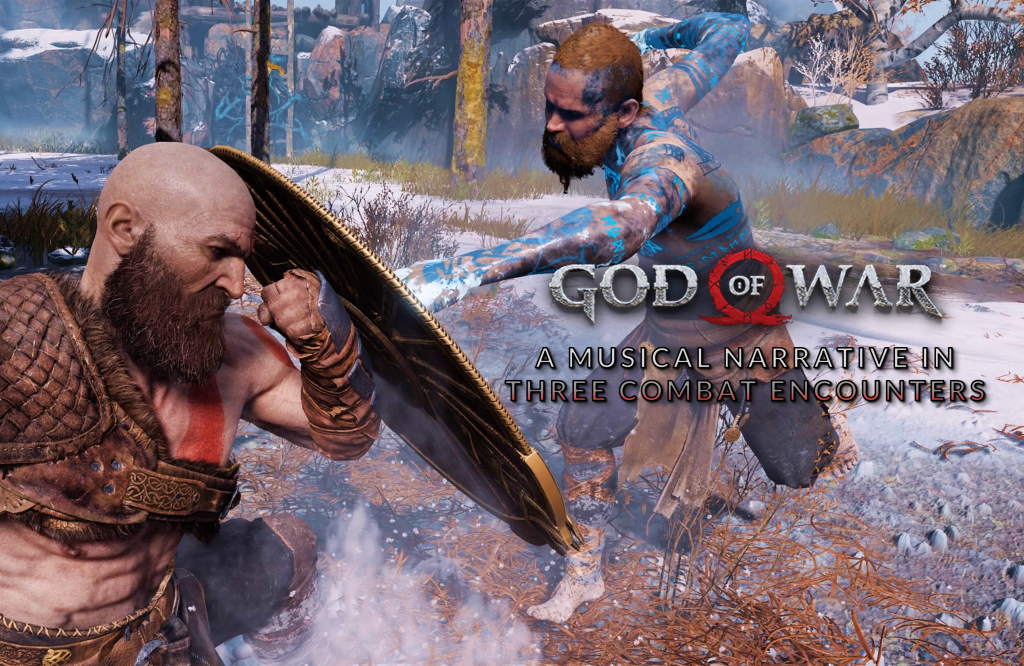
Nowhere is this dramatic structure more apparent than in the development of the conflict with Baldur, the main antagonist of the game. He hunts for Kratos and Atreus for the entirety of the story and the game pits them against each other three times– once at the beginning, once around the middle point, and once at the climax of the story. As the narrative progresses, more of him is revealed to Kratos and Atreus, and the stakes for the fights are different. The music then, throughout these three fights, builds in scale and scope, from a small Nordic ensemble to a full orchestra and choir.
It’s a fascinating approach to take for a recurring boss, particularly when one considers that it’s common practice for games to just feature the exact same piece of music in every fight with a recurring boss. And it is precisely because this is not the case that I feel it’s worth breaking down these three combat encounters and taking a look at how Bear McCreary created a musical arc for a single boss through combat music. Let’s take a look at God of War.
The Themes
In an effort to easily represent most of the major characters in God of War musically, McCreary writes a number of thematic ideas for most of the major characters and concepts in the game. I’ll highlight both Kratos and Baldur, both of which get their own themes.
Kratos’ theme is the star of the score, opening the album (in the track God of War) and featuring prominently in the majority of the music throughout the game. It also replaces Marino’s Main Theme from the previous God of War games. The theme consists of a long-lined muscular melody (and a soaring B-section) that instantly embodies the traditional masculinity and brutality inherent to Kratos, but is also malleable enough to be treated to more emotional and vulnerable variations as required by the story. The melody tends to be reduced to a 6-note fanfare that is often used as a shorthand for the full melody during the multiple action cues in the game.
McCreary chooses to represent Baldur by way of a theme comprised of two musical ideas– an ostinato and a melody. Since a lot of Baldur’s narrative arc is encapsulated in Deliverance from the album, I will be referring the most to that track. The ostinato is the nimble, repeating figure that opens the track heard on hammered dulcimers, plucked strings and light percussion; much like the melody itself, this ostinato jumps into bigger and bigger sounds as the narrative requires. The melody is heard not long after (0:09 into Deliverance) on a Hardanger fiddle. Both constructs are meant to represent in equal parts the agility and speed of the character, as well as his relentlessness and the danger he represents in battle. This is somebody who is meant to be taken seriously.
Encounter One: The Stranger
This encounter is divided into three distinguishable stages, all of which are separated by either static or interactive cutscenes.
An hour into the game, as Kratos and Atreus come back from hunting, an argument that they’re having is interrupted by a man knocking on their door.
This man, who up to this point is only addressed to as the Stranger, is seemingly looking for Kratos. Far removed from the angry, blood-thirsty man he once was, Kratos warns the man to leave and not come back. After exchanging a few blows, the Stranger, later revealed to be Baldur, knocks Kratos into the air and engages him in a fight.
The conversation between the two is scored by a slow statement of Baldur’s theme on Hardanger fiddle and small orchestral phrases. The ostinato is subtly hinted at throughout. It’s not until the Stranger shows his power that the orchestra reacts with a sudden burst from the brass and strings (listen to 2:40 in the video below). This gives way to the first stage in this encounter.
McCreary holds back as much as he possibly can during this fight, being scored by a bare-bones rendition of the theme on nyckelharpa and hammered dulcimer performing the ostinato, and Hardanger fiddle performing the melody, subtly accented by a bed of light percussion. Every once in a while, low brass come in with subtle chords, barely adding color to the primarily Nordic ensemble. Even rarer are the accents of a cooing choir. Both men are clearly holding back, and the music takes us on a journey of an increasingly bigger scale.
Curiously in fact, for much of these first moments, it’s actually Kratos’s theme that roars the loudest (like at 5:23), receiving frequent statements on brass while Baldur’s theme remains on Hardanger fiddle and hammered dulcimer. Whether the intention is to lead the player into a false sense of security that Kratos is in power while Baldur is, in fact, secretly toying with him or just a simple but effective way to represent both characters instrumentally, the choice is striking. That approach is taken a step further when Baldur threatens to enter the house and find Atreus, and you can hear at 6:27 how his melody jumps from Hardanger fiddle to orchestral strings, in the first musical show of menace that we’ve gotten for the character.
The threat to Atreus activates Kratos’s Spartan Rage, effectively triggering the next stage of this first fight, with Kratos and Baldur fighting on the side of a cliff. The fight becomes faster-paced and more aggressive, and the music reflects that jump in intensity by shifting from the bare-bones instrumentation of the previous stage to a fuller orchestral treatment of Baldur’s theme, having the strings repeat the ostinato underneath the melody on brass. The loop here is similar to the 0:42–1:39 portion of the Deliverance track on the album, arranged differently, with added instrumental sections and variations to account for the fact that, just like the fight, the music increases in intensity as it progresses.
The third and final stage is triggered after Kratos drops a giant mural stone on Baldur and the game allows the player a moment for Kratos to walk back home. The fight is not over, however, as a short cutscene shows us a hint of Baldur’s true power, and it’s revealed to us that he is invulnerable, cannot feel pain and cannot be killed. The stakes for Kratos are set– he is to defeat someone who cannot be defeated. Then, at 11:10, the final stage of the fight begins.
For this stage, the music doesn’t hold back compared to the beginning, becoming much more of a fully-fleshed, orchestral arrangement of Baldur’s theme. From the very beginning, this was all about building towards getting here, the music growing in scope and scale just like every stage of the fight Baldur displays an increased moveset and grows more and more aggressive.
Everything in this fight and the way it unfolds is informed by the narrative. So is the music. It’s all about introducing us to the antagonist of the game and slowly revealing what a threat he truly is. Musically, McCreary seeks to convey that escalation of danger and spectacle by choosing to slowly reveal his instrumental palette, building from a small Nordic ensemble to a more complete sound with the orchestra and hints of the choir. In that regard, it succeeds admirably. But this is just the beginning– now that Kratos and Atreus have met Baldur, the score gets to play with his thematic ideas.
Encounter Two: The Dragon
Several hours and many events later, Kratos and Atreus make it to the peak of Midgard’s highest mountain to cross the only remaining gateway to Jötunheim. There, they are ambushed by Baldur, engaging him once again. This fight is peculiar in that it’s mostly a cutscene with interactive moments, which means that the score plays a little bit more rigidly, quite like a film in some ways. This allows for thematic statements that are precise almost to the millisecond.
Kratos and Atreus are in a different place in their personal journeys. They are estranged by the time they reach the gateway, stemming from the recent revelation that Atreus is a god, and him being consumed by the idea of being invincible, accentuated by Kratos’s inability to communicate with his son on an emotional level; this estrangement eventually leads to Atreus shooting an electric arrow at Kratos, incapacitating him and allowing Baldur to capture him with ease. Having recovered, Kratos chases after Baldur, landing on top of his dragon, where Kratos and Baldur fight once again.
Musically, this fight picks up where the encounter by Kratos’s house left off. Baldur’s theme is liberally quoted by the full orchestra (like the slower statement at 2:40 in the video below), and wordless choir accents populate the music as the two men exchange blows on top of a flying dragon.
Kratos is eventually thrown off. Baldur and Atreus land on the travel room not long after, forcing Kratos to chase after them. The music follows Kratos with a resolute and energetic statement of his theme at 4:56. He catches up to them but Baldur immediately subdues him, taunting him with the threat of bringing all of Asgard down upon them, the music bringing back the Hardanger fiddle to quote Baldur’s melody. Kratos overpowers Baldur and interrupts the travel process with his theme returning to the forefront, not before being interrupted by anguished strings at 5:53 as Atreus wakes up and begs his father to let him help take down Baldur. Kratos activates the travel room, and the gateway sucks all three of them up.
As Kratos and Baldur fight for Atreus while flying through the skies of Helheim, where the room ended up sending them, the orchestra is sent on a frenzy of aleatoric brass stabs while an electric violin performs glissandi figures underneath (a similarly distorted fiddle effect is used prominently during the exploration of Helheim, so the score might be addressing the sudden shift in location).
Kratos manages to fend off Baldur and grab Atreus, winning the fight. The score responds by concluding the cutscene with an energetic statement of Baldur’s ostinato on strings as both father and son land on Helheim.
The major takeaway of this encounter is how, in taking advantage of the heavily scripted structure of the fight, McCreary manages to craft a heavily thematic sequence akin to one you would hear on film or television, where the character conflict is musically depicted with crystal clarity, the character themes weaving in and out of the music as the characters get the upper hand in the fight. This shouldn’t come as a surprise, as Bear McCreary is a consummate television and film composer, as adept to writing to picture as he is to implementing interactive music.
Encounter Three: The Giant
The third encounter is divided into four stages, all separated by cutscenes and interactive moments.
This final fight concludes the conflict between Kratos and Baldur, and serves as the final step towards resolving the residual turmoil in Kratos and Atreus’s relationship. It is also the longest story-based boss fight in the entire game.
After a cutscene where the Witch of the Woods (long since revealed to be Freya, a Vanir goddess, Odin’s exiled wife, and Baldur’s mother) reunites with Baldur and Kratos interrupts him from killing her, their final battle begins.
During the first stage, as Kratos, Atreus and Baldur fight by the entrance to Thamur’s Corpse, the music is frantic and almost schizophrenic. Baldur’s theme hops across different instruments, from Hardanger fiddle to brass to orchestral strings, almost like the music is constantly at odds between the Nordic and orchestral sounds. Listen to moments like 0:52 in the video below as French horns overpower a lone Hardanger fiddle for a split second, or the huge orchestral swell that comes a couple of seconds after. The music waxes and wanes in intensity alongside the aggressive instrumental shifting. Baldur’s reunion with his mother has shaken him to his core, and the music chronicles his unraveling as the fight progresses.
The second stage of the fight is triggered after reaching a certain damage threshold, starting a cutscene in which Baldur is finally made vulnerable by way of an arrow tip made of mistletoe. Of note is the momentous statement of Baldur’s theme at 2:13 by the full orchestra and choir, serving as both a celebration for Baldur (who can finally feel something for the first time in his life) and defeat for Freya (who cursed Baldur with invulnerability out of fear of losing him). On a deeper, mythological level, even if we as players don’t understand it yet, this is a momentous occasion, and the music makes sure we’re aware of that.
To stop them from further hurting Baldur, Freya moves Kratos and Atreus away from her son, further into the Corpse area. Baldur pursues. The second stage then becomes a matter of them fighting Baldur, and the three of them fending off Freya’s restraints.
Baldur’s theme here becomes more unhinged, almost playing like the villain theme in a slasher film than one for a fantasy character (listen to the high-pitched strings quoting his theme kicking off the fight at 4:10, or the contrapuntal statement of Baldur and Kratos’s themes that is part of the proper loop at 5:10). It also loses ground to Kratos’s theme, which gets more prominent statements on brass and starts to dominate the soundscape. Gone is the determined and confident quality found in Baldur’s theme statements for earlier battles. After all, this is a reckless god who has seen his entire world turned upside down in a matter of minutes, and is spiraling out of control.
This stage ends with Kratos and Baldur being thrown off the arena onto a lower platform, where the third stage of the fight begins. Baldur’s theme dominates this stage, as he grows more dangerous, being able to absorb the ice and fire elemental qualities of Kratos’s weapons. The score rises to the occasion by returning the theme to full orchestra, to signify how dangerous he has become and that he needs to be stopped.
The final stage of the fight begins after a prolonged interactive cutscene where the Kratos, Atreus and Baldur fight all over the reanimated corpse of Thamur to end in a square arena, where things are to come to an end.
“Why won’t you die?!” Baldur shrieks. This line informs much of where his head is at this point in the fight– he’s livid, and he wants those two to die. His behavior is desperate and the most aggressive it’s ever been. He is finally fighting with everything he’s got.
For the score, this is all about paying off the thirty hours of musical build-up that started in that cabin where they first met Baldur. The score launches into a gargantuan orchestral and choral explosion of Baldur’s theme, far removed from how it started on Hardanger fiddle and hammered dulcimer.
He’s no longer toying with Kratos and he’s not in control– he’s out for their throats. Short bursts of Kratos’s theme rise up to meet Baldur’s threat during this stage, but this is all about us players understanding the peril in which Kratos and Atreus are.
The fight comes to an end with an interruption from Freya, as the reanimated corpse of the giant tries to incapacitate Kratos and his son, forcing Atreus to call on the World Serpent, being thrown away from that arena and back into the area of the first stage.
The cutscene that follows could very well merit its own article. The fight however, for all intents and purposes, has ended, with Baldur having been defeated.
Conclusion
It’s more common than you might think to have games with recurring bosses quite like Baldur– bosses that you fight multiple times throughout the game and face them one last time in the end.
It’s rare, however, to have that journey of facing the boss at multiple moments in the story be represented in the music, often developers just being content with reprising the exact same cue over the multiple fights in the game.
And the choice of scoring each fight differently, based on where the character is in the story is a sound one. Acknowledging character evolution and story progression is media scoring 101. The character has evolved from the first time they fought the boss (and oftentimes, so has the boss), so the music should reflect that change.
In God of War, every character goes through a journey, even if it’s not of a geographical nature, most of all Kratos, Atreus, and Baldur. The three of them face each other at different points in their journeys, so the music does the job of acknowledging that difference in character each time they fight.
The developers also choose to slowly unveil the threat of Baldur over the course of the first fight, and the game as a whole. The music does a bit of the heavy lifting, building from the smallest ensemble to the biggest orchestral and choral sound. The transformation that Baldur’s theme goes through is masterfully handled by McCreary, offering one of the best musical experiences in gaming of 2018.
This approach to boss scoring is a remarkable example of conveying story and character through music in a way that best takes advantage of the medium, recognizing the true potential of video game music as a powerful storytelling tool and more than just a mood-setter for combat and exploration.
GOD OF WAR
Music by Bear McCreary
Additional music by Jason Akers, Omer Ben-Zvi & Sam Ewing
Orchestrations by Edward Trybek, Henri Wilkinson & Jonathan Beard
Music conducted by Bear McCreary, Hörður Áskelsson, Ben Parry & Miriam Nemcova
Recorded by Nick Wollage, Sveinn Kjartansson, Jan Holzner & Nick Spezia
Mixed by Steve Kaplan
Score produced by Keith Leary & Peter Scaturro
 Game Music Hub