
DISCLAIMER: Contains mild spoilers from Ori and the Will of the Wisps’s main story.
When Ori and the Blind Forest was released back in 2015, it took the gaming world by surprise. Its combination of tight platforming mechanics, engaging combat, rewarding Metroidvania exploration and emotional storytelling resonated with a lot of players around the world. Its music was written by then-newcomer Gareth Coker, who provided a vibrant and expressive score that perfectly complemented the gorgeous visuals and moving narrative.
The game developed a core, passionate fanbase that immediately started pushing for a sequel. This desire for more of the game wasn’t a guarantee of getting one, though, given the game’s standalone narrative and well-rounded gameplay mechanics, and it would actually take two more years for Moon Studios to announce a sequel.
Ori and the Will of the Wisps was ultimately released in March of 2020 to critical acclaim and positive reception from players. Though it was overshadowed by bigger, more popular games from the same year (in fairness, 2020 was a spectacular year for the industry), the general opinion I saw going around was that, while not many people played it in comparison to the bigger titles, those who did couldn’t deny how great it was, and often championed it for other people to experience it.
Will of the Wisps was a huge upgrade from its predecessor in nearly every regard. Major overhauls to the combat, massive enhancements to the traversal and deeper, richer level design gave us a game that we didn’t know could exist in this franchise. The level of detail put into every single aspect of it was a sight to behold. Moon Studios’s love and passion for this game shows at every turn. They knew that there were a lot of places where they could take the sequel, and went above and beyond to realize their vision for it.
Like the rest of the developers, Gareth Coker sought to expand the scope and emotional range of his score, populating the music with a multiplicity of new themes, in addition to a number of returning ideas from the first one, as well expanding the sound of the game. The score for the sequel is darker and weightier than that for Blind Forest, its emphasis on choral writing and the deeper registers of the orchestra is noticeable, while still feeling like a natural extension of the sound from the first game.
As I’ve already mentioned, Will of the Wisps brought a major overhaul to the combat system as well as the addition of several new traversal abilities. The combat system was upgraded with a vast array of tools and abilities to help Ori deal with enemies.
Cementing this diversification of Ori’s combat skills was the addition of more traditional boss fights. While Blind Forest did feature bosses, the only way for Ori to progress was to outrun and escape them. In Will of the Wisps, they have to fight and defeat them to progress.
One of such bosses is Mora, ruler of the Mouldwood Depths, whom Ori has to defeat to acquire the Eyes of the Forest, one of the three Wisps required to restore the light in Niwen.
One would think that, with the addition of proper boss fights, the music system in this game would have to change from its predecessor in order to address them, but the truth is that it didn’t, and it only goes on to prove that, even while working with extremely simple music implementation, a composer can still create a powerful impact with their music.
Let’s take a look at Mora’s boss fight in Ori and the Will of the Wisps
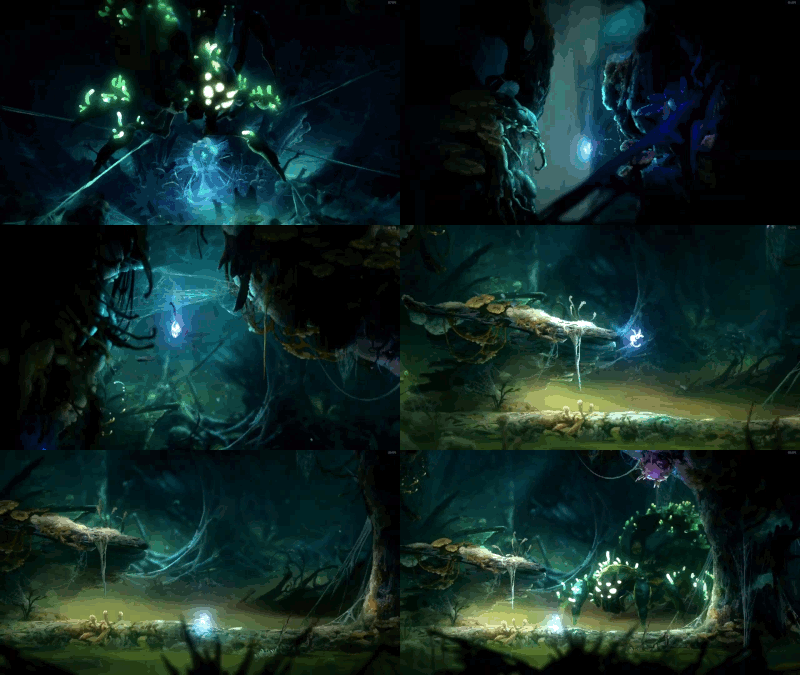
Due to the non-linearity of the level design, Ori may arrive at Mouldwood Depths at different points in the game with a vastly different set of equipment, which then has a significant impact on the length of Mora’s boss battle.
Mouldwood Depths, realm of Mora and her children, is an area enshrouded in darkness, harmful to Ori when exposed to it. They have to rely on light sources to survive traversing it, and then use a special skill which is unlocked while exploring it.
It is intentionally designed to be as scary and unnerving as the Ori games have ever gotten; to compliment the disorienting feel of not being able to see much around you and having to rely on fixed light sources, the audio department cooked up a very creepy atmosphere, full of subtle noises mimicking creatures slithering about and whispers in the dark. Gareth Coker adds to the mix with his eerie Shadows of Mouldwood track and its thick string clusters, cooing choir and violin glissandi.
The game eventually leads Ori to the innermost part of Mouldwood, triggering a cutscene where they find the Wisp they came looking for. Mora appears looming in the shadows, shattering the ground below Ori, who plunges into a deeper structure. There, the fight begins.
As I’ve already mentioned, Will of the Wisps’s music system is very simple, but no less effective because of it, and Coker takes advantage of those limitations to tailor his music around them. Every single piece of music in the game is implemented as a fully-mixed stereo track, much like you end up hearing them on the album, minus the necessary tweaking and mastering to optimize them for isolated listening.
So they all loop as entire pieces of music in a very traditional Metroidvania sort of fashion. Where it ends up improving over the traditional Metroidvania formula is with its rigorous trigger points. The only times where the game switches music cues are when the player reaches specific, premeditated points that serve as triggers for the transition between cues. These take the form of certain rooms in-between the major areas in the game, cutscenes or boss fights.
For boss battles, this means that a single cue loops over the fight, with specific trigger points for certain bosses, like Mora. She’s a multistage boss, with two stages and a chase sequence in-between them. All three gameplay events have specific cues attached to them, and them, along with the cue for the cutscene that begins the fight, comprise Mora the Spider on the album.
For this article, I will be referring to two different YouTube videos, found at the end of this article, which showcase certain gameplay differences that will become important in a little bit. It’s not necessary to watch them both in its entirety. I will be pointing out what’s important about them as it becomes relevant.
The first stage (which, gameplay-wise is subdivided in two smaller phases) is scored by a loop of 0:39 — 3:19 from the aforementioned Mora the Spider. A strident cello ostinato gives way to descending orchestral and choral phrases. The strings introduce an action variation of the motif that recurs throughout Shadows of Mouldwood (which itself seems to mildly resemble Shriek’s theme, as heard halfway through the explosive Shriek track), followed by a reprise from the full orchestra. My favorite moment from this particular loop is the fabulous whisper-chanting from the choir at 2:15 in the track, backed by a bed of staccato woodwinds and string drones; not only is it a fun, creative little musical moment, it also goes a long way in using music to give Mora a personality.
Up to this point, the music behaves in a pretty standard fashion, as a simple loop. Though this will depend on the number of abilities that Ori has collected beforehand and the skills of the player themselves, the developers don’t expect players to linger for too long on this stage. In fact, the player can even trigger the second smaller phase in this first stage (in which Mora will break through the right wall and expand the arena’s size, as illustrated at 1:26 on the first video below) before the cue even reaches the halfway point. If the player is skillful enough, the first stage as a whole can be over before the cue even reaches the end of the loop; on the first video, at 2:25, the player triggers the subsequent chase sequence almost an entire minute before the end of the cue.
In fairness, though, the nearly three-minute cue is already quite lengthy, when most individual loops for boss battles tend to clock in at half of that. Even if a player is not quick enough, the generous length will ensure fewer loops, and thus fewer chances of the player feeling the repetition in the music.
The chase sequence that follows the first stage is triggered after inflicting a certain amount of damage. Mora recoils to the background and starts stomping the ground. Ori has then to escape up a hollow tree trunk and platform their way out of Mora’s claws to reach an upper level, where the fight will then resume.
This is probably the most interesting point for music implementation in the fight. Coker writes a cue specifically tailored for this moment, encompassing 3:19 — 4:00 on the Mora the Spider track. A couple of things worth mentioning– the first is that this cue doesn’t loop, unlike every other cue written for a chase sequence in the two games; the second is that the cue is about fifteen seconds longer than it would probably take the average player to traverse through the platforming section. This, I believe, is fully intentional.
Like I’ve said, boss fights are a new feature in Will of the Wisps, and because of that, their format by this point is still foreign to the regular Ori player. Which is why the idea of there being a chase sequence halfway through a boss fight is even more unusual.
The developers were probably aware of this because of how, when Mora starts stomping the ground and rocks fall from above, they break every bit of the ground surrounding Ori except for the center portion, which stays undisturbed until Ori actually starts bashing up the tree trunk, after which Mora destroys the ground and starts chasing after them. This is a design failsafe that allows players to take the necessary amount of time to understand that they’re supposed to start bashing their way up and they’re not meant to continue fighting.
Coker built a failsafe in his score as well to ensure proper timing of the music in the event of one situation– that the player takes a bit of time to realize that they’re supposed to escape. That failsafe is those extra fifteen seconds that Coker wrote in the cue. The music accounts for a player taking longer than normal to reach the end of the sequence to the second arena which, presumably, is the expected behavior. After all, this design choice is new to this game, and it could reasonably disorient the player right away.
If the player does take longer than normal, then they might reach the second arena by the time that the music reaches the transition to the second loop (4:00 into Mora the Spider), creating a satisfying moment when the second stage of the fight begins just as its corresponding loop is triggered (from 4:00 to the end of the track); if they don’t, then the non-looping cue will continue its course until it naturally reaches the transition, even if the fight has already resumed. The player in the first video, for example, safely survives the chase sequence in a single try and reaches the second arena well before the non-looping cue’s ending.
That failsafe can only account for so much, though, and interestingly, it doesn’t account for one of the things that the Ori games are known for– player death. Since it’s a non-looping cue, once it reaches its ending, it automatically transitions to the looping cue for the fight’s second stage, which is dominated by Ori’s theme. This means that if the player takes too long on that sequence, either by dying repeatedly while traversing or by taking an abnormally long time to start escaping (or both), the cue will just end before the player even reaches the second arena, and the new cue will then just continue looping until the entire fight is over.
One could make the argument that, if the player were quick enough, they could still make it to the second arena in time for the transition, but they would have to be ungodly fast for that to happen. At least in my experience and gameplay videos that I’ve seen from other people, one death is enough for a player to miss their window. On the second video, for example, the player triggers the chase sequence at 3:20, but has to retry due to getting killed by Mora; they ultimately reach the second arena, but the second looping cue has already started by then.
This does beg the question of why this specific cue wasn’t implemented as a loop, since there’s every chance for a player to die dozens of times during the sequence and thus miss the window for the second stage entirely. It could have been any number of reasons, like wanting to avoid unnecessary repetition of this particular cue, trying not to add more stress to an already very stressful sequence, not wanting to waste that extremely satisfying transition to that second looping cue, or maybe they simply did genuinely expect the regular player to traverse the sequence in a single try.
The second stage of the fight takes place on this second arena above the first one. The music for this stage launches into a soaring statement of Ori’s theme by the full orchestra and choir. The adrenaline rush is palpable as the player is coming off an intense chase sequence and into the final stretch of the fight. The way Coker builds to this moment with his music is masterful, and a pitch-perfect example of a composer capturing the emotional arc of a boss fight with their music.
Much like the loop for the first stage, Coker accounts for repetition by writing a sizable two-minute cue to accompany the fight.
As Mora is defeated, the simple loop is interrupted by a non-looping cue that scores the cutscene where she’s finally freed of the darkness that consumed her, and Ori obtains, finally, the Wisp that they went there to find.
Gareth Coker has spoken at length about how playtesting the Ori games endlessly himself has allowed him to tweak the music as many times as necessary to create the intricate trigger points of the music system, which end up giving the impression that the score is implemented more complexly than it actually is.
That exhaustive work pays off spectacularly here. Mora’s fight highlights the importance of precisely that, tailoring the music to a specific boss battle, and I don’t only mean that on a conceptual level of making sure that the musical content fits the character (which Coker does really well), but also the emotional arc of overcoming a difficult boss fight and how its implementation within the game executes that.
Mora the Spider is a beautiful confluence of all the elements that make video game music pack such a powerful punch, and make a case that it doesn’t really take an overly complicated music system to score a game, but it does take a composer who understands the medium in which they’re working, and provide a musical experience that takes advantage of it.
ORI AND THE WILL OF THE WISPS
Music by Gareth Coker
Orchestrations by Zach Lemmon, David Peacock & Eric Buchholz
Music performed by Philharmonia Orchestra & Pinewood Voices
Conducted by Alexander Rudd (orchestra) & Allan Wilson (choir)
Featured performances by Aeralie Brighton (vocals), Kelsey Mira (vocals), Kristin Naigus (woodwinds) & Laurent Ben Slimane (bass clarinet)
Recorded by Jake Jackson
Mixed by Steve Kempster & John Kurlander
 Game Music Hub