
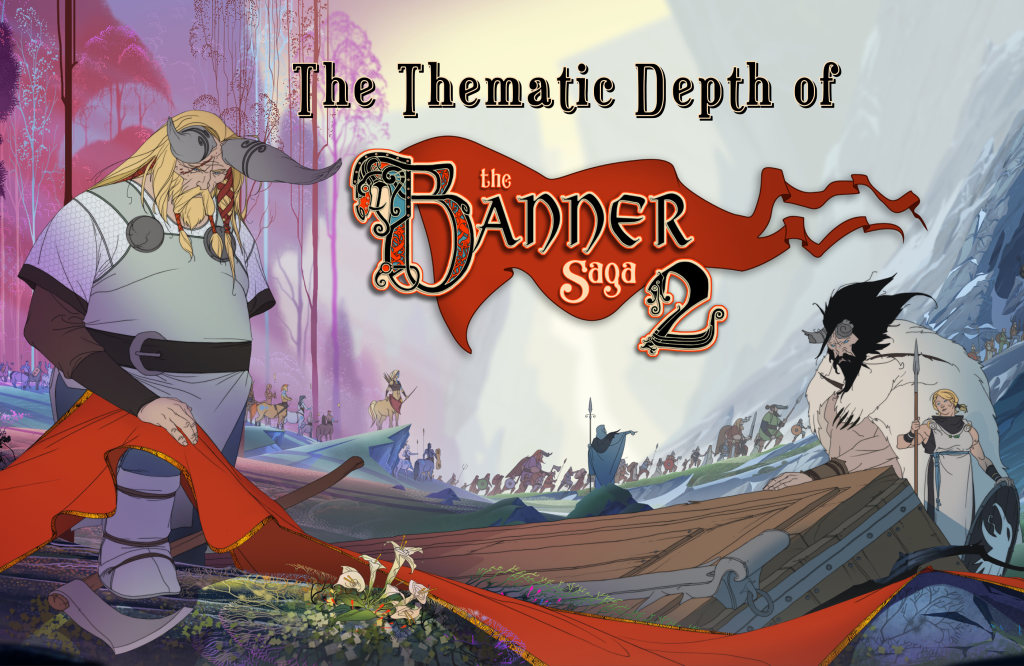
It’s The Banner Saga month in Game Music Hub! This article continues a four-week coverage on Austin Wintory’s stunning trilogy of scores for the tactical, turn-based RPG series of games.
This is the continuation of the series The Thematic Depth of The Banner Saga Trilogy. Click here to read the first part, which discusses at length the score for the first game.
DISCLAIMER: This article contains MAJOR spoilers for The Banner Saga 2.
The Banner Saga 2 picks up right where the first game left off, with our unified caravan of survivors from both Einartoft and Boersgard, led by the surviving Rook or Alette (who will be referred to as the Hero from here on out), travelling to the human capital of Arberrang in the hopes of finding safety behind its walls amidst the ending of the world. Partway through the game, a group of mercenaries called the Ravens, who joined the caravan at the end of the first game, leave with some members of the Hero’s caravan on a mission for Juno. Thus the caravan once again splits in two. Soon, as the threats of the giant serpent and the impending Darkness grow larger and more dangerous, Juno and Eyvind find themselves heading for the one place where both can be stopped.
The sequel score by Austin Wintory is very much an extension of the first game’s score, staying relatively the same sonically, while doing some key upgrades to the instrumental and thematic palette and evolving what’s already there to serve the increasingly complicated story.
All of the themes from Banner Saga 1 return for the sequel, with two new ones joining the fray.
The first of these new themes is what Wintory himself calls the “War Anthem.” It’s a long-lined melody, often sung rather than performed by instruments, and it represents a war-cry of sorts for the caravan. There’s a sense of hope in the middle of hopelessness that permeates the second and third games as the situation of the members of the caravan turns more and more dire, a feeling of them slowly coming to terms with the idea that they may not survive the ordeal, and they’re just finding a way to prepare for the end.
The War Anthem represents this emotional dimension, this quiet resignation, in a way that the traditional Caravan Motif cannot. It makes its presence known pretty early during the title card reveal after the game’s short prologue, which is scored by the cue spanning 0:00-0:33 in the track The World is Breaking from the soundtrack album. It also goes on to form the basis for the end credits song, Our Steps, to the Night, performed by Árstíðir.
The second new thematic idea is the Ravens Theme, which represents the aforementioned group of mercenaries and, more specifically, their varl leader, the berserker Bolverk. The theme is an ambiguous seven-note melody that always seems on the verge of devolving into pure dissonance, not unlike the bloodthirsty, impulsive Bolverk. Most of the time, Wintory surrounds the theme with nasty arrangements for the lower register of the wind ensemble, further enhancing the uneasy feel of the melody. I’m a huge fan of the music for the Bolverk-centric chapters for this exact reason.
Just listen to its first appearance on the album, at the 1:08 mark during Under the Black Banner. Wintory writes dissonant, almost guttural contrabassoon and contrabass clarinet lines around the trumpets quoting the melody. Deep into the Rocks twists the theme even further to the absolute lowest tones the low woodwinds can muster at 0:26 (with Juno’s theme tailgating it on clarinet).

A secondary, albeit independent, component of the music for the Ravens is Árstíðir. The Icelandic trio (quartet at the time, consisting of Ragnar Ólafsson, Gunnar Már Jakobsson, Daniel Auðunsson and Karl James Pestka) lent their voices for this game, primarily singing the aforementioned end credits song (which we’ll get to later), but they also serve a very striking narrative purpose.
Wintory has them sing special chants that serve as intro cues for combat encounters in the Bolverk chapters, almost like war-cries to rally Bolverk’s party before a fight (not unlike the chants sung by Peter Hollens in the first game). Where Our Steps, to the Night is sorrowful, these chants are more primal. You can find examples of them at the very beginning of With Eyes to the Endless Sun and Even the Trees Can Smell Your Blood. These chants will also feature in an even more striking fashion during the third game, as Wintory cleverly repurposes them to fit a different, though related, narrative need.
In a way, the Ravens theme and the Árstíðir chants are a very effective way to immediately distinguish one caravan from the other when both of them split at the beginning of Chapter 9. The Hero’s caravan has the main theme spearheading it alongside the hero motif, the War Anthem and the caravan motif, all of which are much more overtly heroic (or at the very least more harmonically pleasing). On the flipside, the journey of Bolverk’s caravan is scored by more dissonant arrangements and the complicated, crunchy harmonic embellishments of the Ravens theme coupled with the unnerving textures for the Dredge and the Darkness.
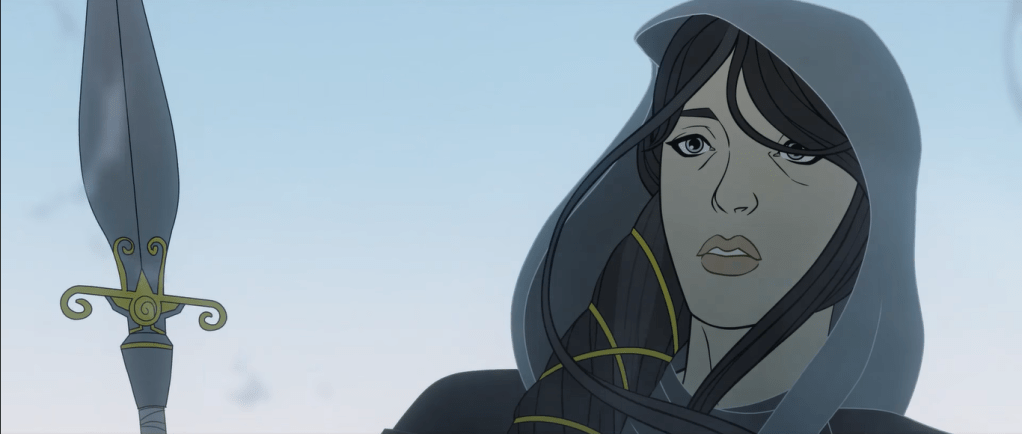
The Banner Saga 2 also sees Juno’s Theme take a more central role in the narrative of the score. Its first prominent appearance happens during A Path Through the Skies, which scores a lengthy sequence in Chapter 8 where the unified caravan crosses a gigantic chasm made by the Serpent with the help of a bridge created by Eyvind’s thread-weaving (the game’s version of magic). Listen for the trumpets at the 0:33 mark and then at 1:50. This first half as a whole scores the fights leading up to the crossing of the chasm, while the second half scores the crossing itself (listen for the main theme stated on trombones at 2:30, closely followed by French horns echoing them).
What’s really interesting about this jump in prominence is that it’s not really tied to Juno and Eyvind as characters themselves or their narrative arcs, but rather how much their actions begin to influence other parts of the story. The Ravens initially leave the main caravan out of other intentions, but Juno ultimately makes Bolverk honor an agreement they had between the first and second games– to safeguard, and then dispose of a crate containing a valuable item.
This plot thread jumpstarts the trajectory of Bolverk’s character arc during the second game, even if Juno very clearly stays with the Hero’s caravan. Her theme is never far behind during the chapters with Bolverk as the POV character, being subtle reminders of why his caravan is where it is. Listen to the travelling cue Only Snow can Shield the Sun, which hints at the theme during 0:47, and then at 1:26 surrounded by the same gnarly low woodwinds as the Ravens theme, or at 1:46 during Blades Yearn for Courageous Blood, with Juno’s theme sneaking into the larger horn line.
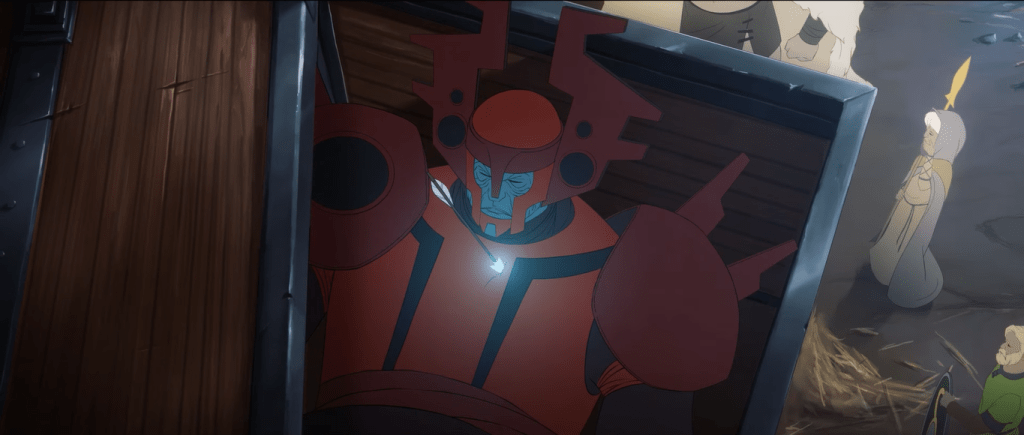
When the contents inside of that crate are finally revealed to be Bellower’s body, defeated in the first game and still under the curse that makes him believe he’s dead, Bolverk understands just what Juno really asked him to do and the theme almost takes on the form of a token figure of Bolverk’s bitterness.
This bitterness eventually grows into hatred when Bellower’s consciousness trapped inside his cursed body starts influencing and taking over Bolverk’s mind. As the journey turns more and more dangerous, eventually taking them through corners of the world that the main characters won’t even explore until the next game, Juno’s theme takes on even more twisted, aggressive variations.
I’ve already mentioned Juno’s theme tailgating the Ravens theme during Deep into the Rocks, but listen to Even the Trees Can Smell Your Blood, which plays when Bolverk’s caravan is forced to go through underground passages in Chapter 11. A flute quotes fragments of Juno’s theme at 0:30 while underneath the Darkness Textures make their first appearance in this score (this is also the first time we physically see the Darkness manifesting throughout the land and the effects it has on living beings entrapped by it) peppered with glimpses of the Dredge Textures.
Meanwhile, in our other storyline, the Hero still tries to lead their caravan towards the safety of Arberrang while dealing with their own personal grief about the events at Boersgard. Compared to the first game, Wintory scales the Hero Motif back this time around, letting the character themselves carry the bulk of their narrative arc in this game.
Its first appearance in-game happens during Chapter 8, as the caravan leaves the small village from the prologue. The travelling cue Faces to the Wind plays over this sequence, with the familiar sound of Taylor Davis’s violin performing the motif; however, it soon gives way to the main theme, quoted by horns underneath a rhythmic figure on woodwinds.
The travelling sections of Chapter 10, up to the reaching of Grundar, are scored by Promises of Sanctuary, which pits a mournful setting of the motif (on violin as well) with a larger, slower French horn figure. Then, after the caravan leaves Grundar, The Endlessly Grasping Bogs takes over, with the hero motif still sneaking its way into the busy woodwind writing (listen for the 1:26 mark).
Given the hero motif’s relative step back, Wintory takes the chance to increase the role of the Caravan Motif in the narrative of the music for the Hero-centric chapters. It introduces the Hero, Iver and Hakon as they rescue the villagers during the prologue, scored by 2:30 during The World is Breaking (also listen to the main theme on low brass playing contrapuntally with the caravan motif).
And even though it very much represents the Hero’s caravan, you can hear this motif in other, more unexpected places, like Bolverk’s caravan. Listen to Under the Black Banner for the 1:23 mark, as low woodwinds bring up a warped variation of the caravan motif. More interestingly, during Even the Trees Can Smell Your Blood, Wintory blends the Ravens theme and caravan motif together, creating a new melody altogether.
The caravan motif is a prominent part of the cues that make out Dragons in the Mud, which play over various combat encounters with the Hero’s caravan during Chapter 10, at first on portentous French horns at the 0:17 mark with contrapuntal trombones quoting the Action Motif. Wintory explores that blend even further when he has the French horns quote an amalgamation of both motifs at 0:57.
The action motif itself doesn’t make many appearances in the second game. The opening cutscene re-introduces the series of two-note gestures as Iver discusses their current situation (1:33 into The World is Breaking). Other than being thoroughly explored in Dragons in the Mud as the Hero’s caravan fights their way to Arberrang, it doesn’t appear again until the finale of the game.
As I’ve already mentioned, the Main Theme mostly sticks by the Hero’s caravan, unlike the first game where the theme tied the separate storylines together. This is an interesting choice, if only because it allows Wintory to maintain that general dour, dissonant, almost purposefully-alienating atmosphere during the Bolverk-centric chapters.
You can hear the main theme appear throughout all the chapters with the Hero as the POV character, initially during the various travelling cues for the caravan, like at 0:47 into Faces to the Wind, then later during key events in the story, such as when Iver leaves the caravan to join Juno and Eyvind to stop the Darkness, a moment scored by the cue starting at 1:27 into Paths Part (more on that and later events of the story in a bit).
As Bolverk’s caravan passes through the underground tunnels connecting the land in Chapter 11, he starts getting visions from the cursed Bellower. The Dredge chieftain is slowly taking over the varl’s mind. During that chapter the Ravens meet another mender of the same rank as Juno, called Zefr. She tells Bolverk that Juno was sentenced to death by the mender council, and convinces him to travel to Manaharr (headquarters of the council) to examine Bellower’s body.
The end of that chapter sees the caravan finding the surface again, only to discover the Darkness rising on the horizon. The 18-second cue that opens The Twilight Flight scores this moment, with Juno’s theme crescendo-ing to an explosion of aggressively distorted Darkness textures, the score drawing connections between the two before the game itself reveals that to us.

Chapter 13, the following Bolverk-centric chapter, finds the caravan restlessly powering through a frozen wasteland to get to the Old Ford, a fishing village that will get them to Manaharr. Wintory whips out the fabulous one-off fanfare from The Twilight Flight to accompany the exhausting march of the caravan.
Also as an eternal fan of low woodwinds, how great is that contrabass clarinet figure at 0:40?! This track is filled with brilliant moments for low woodwinds, like those ascending runs at 1:01, or that descending line trailing off the fanfare at 1:46. I could legitimately spend dozens of paragraphs gushing over those neat, little details in the writing, but let’s get back to business.
The caravan’s arrival to the Old Ford is scored by an explosion of the Ravens theme playing in counterpoint with the one-off fanfare closely followed by Juno’s theme on trumpets (1:37 into The Twilight Flight). Combat scenarios during this part of their journey are scored by With Eyes to the Endless Sun, which continues playing with both the Ravens and Juno’s themes, tying Bolverk and Juno closer together with pure musical storytelling. You can also hear the Dredge textures lurking in the background.
Eventually, during their stay at the Old Ford and in the middle of a Dredge attack, Bolverk finally snaps. Bellower takes over, and Bolverk surrenders his mind to him, storming off to Manaharr with Zefr and carrying Bellower’s body –his own body– while leaving the Ravens behind.
On the way to Arberrang, during Chapter 12, the Hero’s caravan is surprised by the giant Serpent, who bursts from the ground and swallows Juno and a portion of the caravan whole, scattering the rest in the chaos. Inside of it, Juno has a telepathic conversation with the Serpent, where they discuss the nature of the Darkness, the Serpent’s purpose, and other complicated subjects best left out of this article. This moment is scored by the ambient ruminations of the Darkness and Dredge textures from the cue starting at 0:31 in Broken Shells. Occasionally, way in the background, you can hear a violin whispering fragments of Juno’s theme.
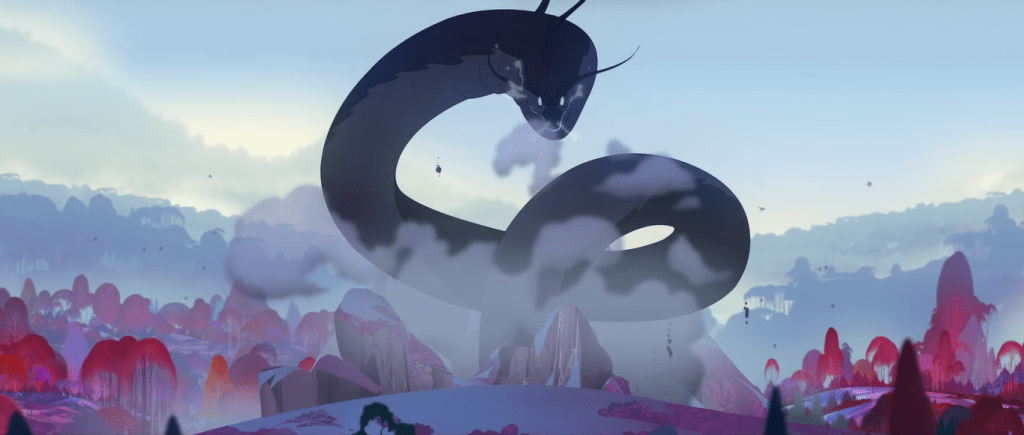
Their conversation is interrupted by Eyvind who, with his spell-weaving, manages to pierce open the Serpent and rescue Juno, the Serpent fleeing out of sight. It is then clear to them that they’re no longer making the caravan safe– they’re attracting danger to it. So they resolve to leave and, in the process, seek out the root of the Darkness pouring into the land. They imply to the Hero that Juno and Eyvind have some unspecified connection to it, and they’re the ones that can make it right, but they want Iver (the Hero’s closest ally/best friend) to go with them.
Iver agrees to go with them, not knowing if he will return or see the Hero again. The last portion of Paths Part plays as they leave on boat, the main theme on horns bidding Iver farewell, with the fragile tones of the violin underscoring the Hero being left without one of their most sturdy, trustworthy pillars since they began the journey back in Skogr.
Before the trio can begin their journey into the Darkness, though, they have to make a stop… at Manaharr.
At last, the Hero’s caravan makes it to Arberrang, which they find to be in just as much chaos as Boersgard was at the end of the previous game. However, this time something is different– there is nowhere else to go. The Darkness has already cornered them. Whatever happens to the caravan before the end, it will happen at Arberrang.
Ludin, the human Prince who has been part of the Hero’s caravan since Boersgard, goes to meet his father the King. The Hero’s caravan, depending on a number of choices made by the Hero, will be either let inside the gates, or left out. The manipulative Rugga, governor of Boersgard, has also been travelling with the caravan since the ending of Banner Saga 1, and will be a further source of discord with the King.
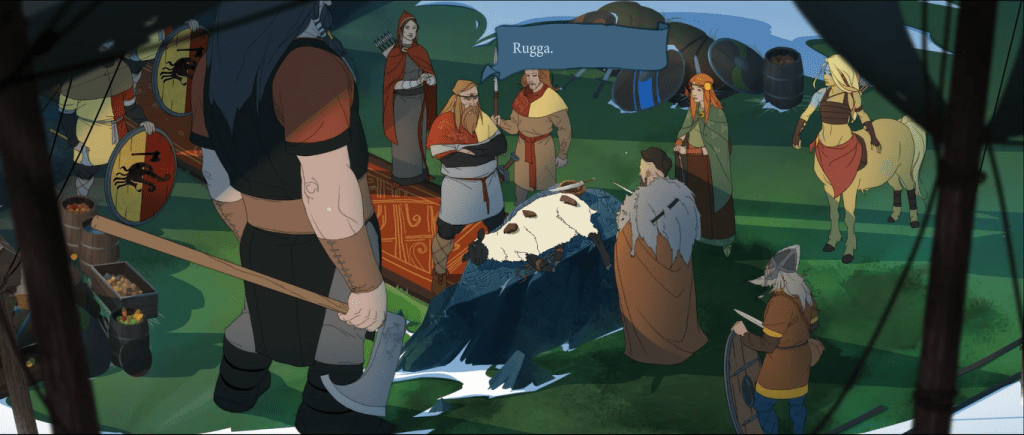
In the end, Rugga and a host of clansmen from various people scattered outside the walls, plan an assasination attempt on King Meinolf and the Hero’s choices will lead them and their caravan to either 1) side with Rugga and fight against the King, or 2) side with the King and fight against Rugga.
Whatever the choice, a two-stage fight ensues… and Threads Unweave comes into play.
The lengthy, climatic track consists of five separate cues, three of them being action cues which play at different moments in the game– the first and third play during the final fight at Manaharr, and the second one (from 1:58 to 4:00) plays here, during this fight at Arberrang.
The fight is scored by complex action music, with sudden bursts of the main theme (on trombones at 1:58, then on muted horns at 2:39) and the action motif (at 3:28, and you could make the case that the percussive low woodwind figure at 2:31 alludes to the same).
An interesting amalgamation of the main theme and the caravan motif surfaces in this cue. Listen to the 2:47 mark as the horns quote the main theme before they smoothly transition to the caravan motif. Then, at 3:30, a single trombone line picks up the amalgamation among the larger trombone statement of the action motif. This sort of clever thematic manipulation, only occasionally displayed in this game, will play an even larger role during The Banner Saga 3.
This storyline is ultimately left unresolved, with Arberrang’s fate hanging by a thread and the Hero caught between two sides of a civil war in the middle of the apocalypse. The third game will pick up right at this point.
Bolverk, Zefr, Iver, Juno and Eyvind all converge in the Tower of Manaharr. The game’s narrative gets messy at this point, so I’m gonna leave most of the specifics out. As Juno, Eyvind and Iver are attempting to retrieve an important object, Bolverk and Zefr barge into the tower with Bellower’s body. Iver, realizing that Bellower has taken over Bolverk’s mind, attacks him and, helped by Juno, one last fight ensues.
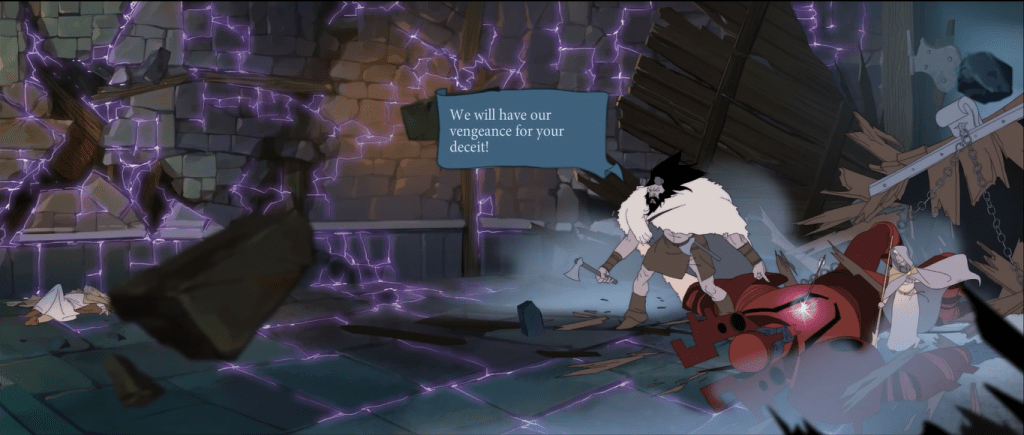
The cues from 0:41 to 1:57 and from 4:08 to 5:20 score this fight (the latter is triggered after a certain damage threshold). An explosion of the main theme/caravan motif amalgamation begins the encounter. The cues are mostly dominated by the overpowering Ravens theme roaring through the French horns, almost mirroring Bolverk’s primal screams, which themselves come from Bellower’s abilities manifesting through him. The second cue introduces an even more twisted, jagged variation of the Ravens theme at 4:52, with the trumpets blaring for all they’re worth.
Finally, as Bolverk is defeated, Eyvind’s spell-weaving results in the collapse of the tower. Juno’s theme blasts aggressively (4:00 into Threads Unweave) as the building crumbles.
The final cutscene of the game rounds up the many hanging threads of the story. Zefr’s fate is unknown. Bellower’s body is taken by Juno, Eyvind and Iver; on the way to the Old Ford, they dump it into the depths of the water. Bolverk’s body is left behind, but the Serpent appears before him, reviving him and placing him under his control. Arberrang is left in shambles, on the verge of civil war while the Darkness approaches. Juno, Eyvind and Iver meet with the remaining Ravens, who join them on their quest into the Darkness.
The cue that starts at 5:26 and concludes Threads Unweave plays over this cutscene. The Ravens theme mournfully watches as Bolverk is visited by the Serpent, quoted by the humming vocals of Árstíðir and the Darkness textures (the latter representing the Serpent). Then, as the visuals shift to Arberrang, the Dredge textures take over, reminding us of the many problems threatening the last bastion of civilization. Then, finally, as we shift focus one final time to Juno entering the Darkness, the wind orchestra, supported by the increasingly distorted Darkness textures, rises for one final crescendo.
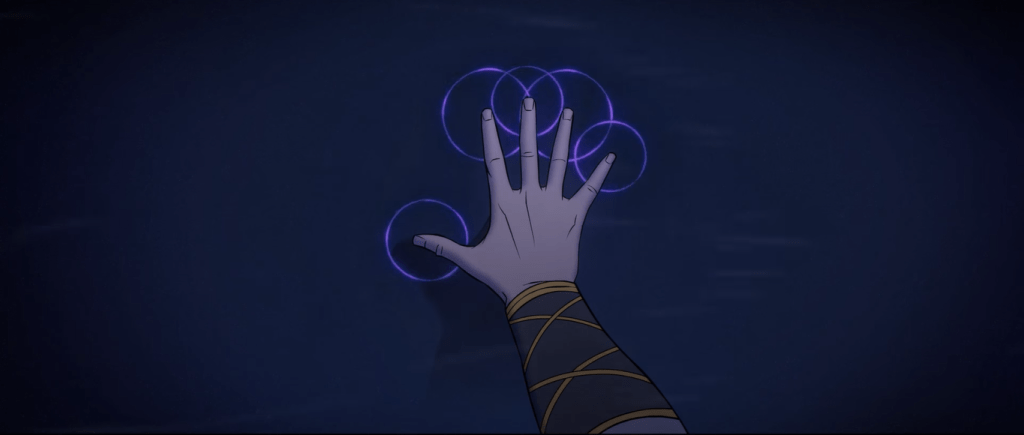
The end credits bring us back to the War Anthem. Árstíðir sings a mournful, if a bit challenging, song that perfectly captures the state of mind of the characters, particularly those in Arberrang. I wrote before about a feeling of quiet resignation, and I believe that Our Steps, to the Night is the best representation of this. In a way, the characters in Arberrang realize that the end is coming and they have no way of stopping it.
That constant despair wears over the characters, the Hero more than most. This will become a major part of their narrative arc going into the final game, with them constantly struggling to maintain as much peace as can be maintained when everybody wants to kill each other, and Wintory masterfully teases that emotional dimension with this song.
Hope in the middle of hopelessness, indeed.
This article concludes with The Thematic Depth of The Banner Saga 3.
THE BANNER SAGA 2
Music composed, conducted and orchestrated by Austin Wintory
Co-orchestrated by Susie Seiter
Performed by The Colorado Symphony
Featuring performances by Árstíðir (vocals), Peter Hollens (vocals), Malukah (vocals), Holly Sedillos (vocals), Taylor Davis (violin), Noah Gladstone (bukkelhorn), Mike Niemietz (prepared electric guitar), Randin Graves (didgeridoo) and Austin Wintory (accordion)
“Our Steps, to the Night” featuring lyrics by Austin Wintory and Malukah, translations by Andri Þór Sturluson
 Game Music Hub