
It’s The Banner Saga month in Game Music Hub! This article concludes a four-week coverage on Austin Wintory’s stunning trilogy of scores for the tactical, turn-based RPG series of games.
This is the conclusion of the series The Thematic Depth of The Banner Saga Trilogy. Click here to read last week’s installment, focusing on the second game, or here if you haven’t caught up and want to read the first part, focusing on the first game.
DISCLAIMER: Contains MAJOR spoilers for the entirety of the trilogy.
As with the second game, The Banner Saga 3 picks up right after the events of the previous game. Arberrang is on the brink of civil war and the Darkness is closing in on the city every day. Moreover, an increasingly large army of Dredge fleeing the Darkness have put the city under siege, wanting to take refuge inside. Meanwhile, Iver, Juno, Eyvind and the Ravens race across the lands already consumed by the Darkness towards the tower of Ridgehorn in order to set things right and stop the ending of the world before it’s too late.
Austin Wintory comes back to conclude the trilogy of music he started with the first game. His final score in the series is still very much an extension of the sound already developed during the previous games. There are a couple of areas where he expands, in keeping with the needs of the story.
Still soldiering on at the forefront of it all is the Main Theme. It debuts during the menu screen, the score introducing the final game with a heavily distorted and dissonant variation of the theme, embellished in the Dredge and Darkness textures. This is presented as Steps, into Memory on the soundtrack album.
It’s worth pointing out the statement at 0:24 because it features the first appearance of a new instrumental color that will recur throughout the score– four woodwind instruments playing in unison, the English horn, bass flute, alto recorder and xaphoon (an instrument of similar timbre to the saxophone), all of them played by multi-instrumentalist Kristin Naigus. Affectionately referred to by Wintory as the Naigus Quartet, this instrumental coloring appears throughout the third game in various guises and for different purposes, the most important of which will be discussed later.
The Banner Saga 3, in keeping with the previous two games, is divided into two storylines, both of which I’ve already mentioned. However, given the myriad of choices that were already made by the player in the previous installments, Saga 3 can begin at very different places for different people (much more so than 2 did after the first game). What this all means is that I will keep the discussion of details in the story to a minimum as much as possible, unless the story and decision-making influence the direction of the score. Otherwise this can quickly balloon out of control with excessive plot descriptions (and trust me, this is long enough as it is).
The Arberrang storyline is led by the Hero and their efforts to keep their caravan and the people inside the city safe from the impending Darkness and the siege from the Dredge. With the Hero coming into their own, the Hero Motif rises once again to become a dominating force in the music.
Taylor Davis’ violin is first heard during the track The True Hero Comes Reluctantly from the soundtrack album, even before the motif appears for the first time. This recollection of cues play over various situations as the Hero deals with the Rugga/Meinolf storyline. Then, in the 62-second cue that opens Encircled Wolves, the motif debuts in all its glory.
But there’s a glimpse of something different in it. Where in the first two games the violin and woodwinds were its signature sound, this time the trumpets take up the small musical figure at the 0:10 mark. And with that change in sound comes a subtle shift in the emotion it conveys. Because while, yeah, trumpets can make the motif sound more heroic, that is not always the case in this game. Here, the theme is performed in a subdued fashion, closer to a lament and far removed from the energetic, agile violin figure that was introduced to us in Banner Saga 1. Our first hint at the larger evolution that the hero motif will go through during this final game; the brass section will quote the motif more prominently moving forward.
That 62-second cue plays as the Hero and their caravan enter the gates of Arberrang in Chapter 16. Not long after, the motif goes back to the violin. Then, a number of skirmishes before reaching the Great Hall of Arberrang will be scored by the second half of that track, starting at the 1:02 mark through to the end. The motif returns to its energetic roots in this smaller-scale action cue.
A second, much more important hint towards that larger evolution happens during this same action cue. The hero motif has always consisted, mainly, of two distinct phrases (though I foolishly referred to it as having just five notes two weeks ago, apologies). The first one is the five stepwise notes, but the second phrase is made out of six ascending notes (listen to the aforementioned trumpet statement at 0:10), after which the motif usually ends up repeating or transitioning to something else.
During the action portion of Encircled Wolves, however, Wintory does something else with the motif. Listen to the violin statement at 1:25– the second phrase has markedly changed. And while Wintory has sometimes made subtle changes to this second phrase for the sake of variation and to fit the motif for different moods in previous games, this time the change means something different. Keep this new second phrase in mind, it will come into play later in the score.
The Juno storyline sees the trio of Juno, Eyvind and Iver cross the Darkness with the remaining Ravens in hopes of stopping it before it consumes the whole world. As the entire storyline takes place inside the Darkness, this is the most thorough the trilogy ever goes in exploring what the Darkness is and how it affects the world. With that exploration, Wintory takes the opportunity to expand upon the Darkness Textures that have been lurking in the background of the two previous scores.
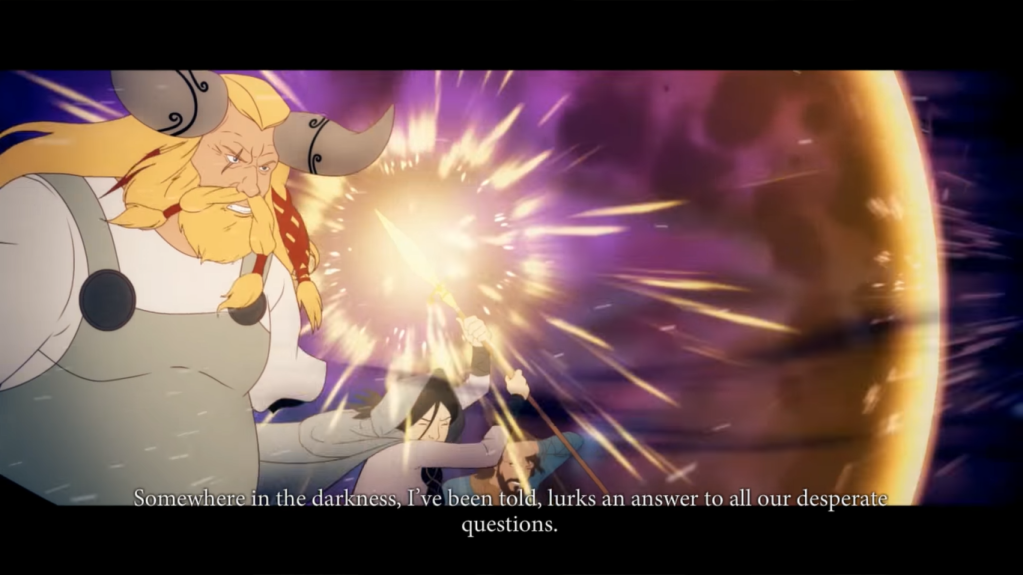
As far as the textural elements of the trilogy, the Dredge textures have always taken precedence. Rightly so, given that the Dredge have been the main antagonists up until this point. The Darkness, on the other hand, has always been a distant threat slowly closing in on them more than it has been a properly defined thing. All that most of the characters know about the Darkness is that it’s dangerous, so those eerie synth drones lurking around every now and again have been a very good fit.
But now that the threat becomes “real”, its effects thoroughly known, the musical palette is expanded to change the way the score addresses it. The beginning of Chapter 17 announces that expansion upfront. After being briefly shown Zefr’s fate after the events at Manaharr, the game moves squarely into Juno’s quest into the Darkness.
The track Raising High Their Shining Light scores these early moments as the party has their first encounter with the Warped (living creatures taken over by the Darkness). Something immediately stands out, and that’s the prominence of various light percussive elements in the music, both pitched and unpitched, alongside the more familiar elements like the high-pitched synths and even hints of the Dredge textures.
The Naigus Quartet makes its first appearance in the score proper, offset by the growling tones of a bass sarrusophone. This instrument, similar in timbre to the bass saxophone and performed by prolific conductor Anthony Parnther, is another new instrumental addition for this score. Although it has the same range as many of the traditional low woodwind instruments, the bass sarrusophone still makes a striking impression due to its punchy, more immediate sound. It also is everywhere in the music, helping establish its sound extensively.
Raising High Their Shining Light sees the return of Juno’s Theme. You can hear it for the first time at 0:22 during this track, performed by the Naigus Quartet. I wrote above about the quartet being a color being used for very specific purposes. Its appearances during the Juno-centric chapters in this game are its most important one. The quartet quickly becomes associated with Juno, being used frequently to quote her theme throughout her chapters, and goes on to play a crucial role during a key sequence later in the game.
Juno’s theme as a whole becomes one of the most prominent themes in the third game, finally standing toe-to-toe with the main theme or the hero motif. Alongside the Darkness textures, it dominates the music for her chapters and, as in the first game, goes on to play an important role in the end credits song.
Back in Arberrang, during Chapter 18, the survivors inside the city face an attack from the Dredge after the Sundr Ruin manages to break through the walls. The Hero is called into action to stop them. The Banner Saga 3 introduces a new mechanic to its combat system called Respite, which gives you the option to continue fighting a new wave of enemy reinforcements after you’ve defeated the previous one (bringing reinforcements of your own, should you want to change your party). The reason I bring this up is because, of course, this has implications for how the score behaves in-game.
While typical combat encounters are scored by a set of two, even three cues that are triggered the further you progress into the encounter, additional waves may sometimes introduce new cues that wouldn’t be heard otherwise. For example, the Hero’s fight against the Dredge on the Arberrang walls is scored by the action cues that make out Steel Flowing as Water (from 0:45 to 1:48, from 1:48 to 2:51, and finally from 2:51 to 3:54); should the player choose to fight a second wave with Respite, a different cue, one not actually found on the album, will play. Most encounters are only two waves long, while others (like this one) have three.
A caveat before we continue– I have never, not once in my three playthroughs of this game, ever fought through a third wave of combat. Again, I have never been good at the combat, so I usually bail out after the first wave. Only in my third playthrough did I go ahead and trigger second waves in an effort to know if the score was affected in any way. Given how brutal second waves were for me, third waves would’ve been suicide with my underleveled characters and poor party assembling. As such, I only have limited information on what happens to the score when triggering third waves, so I’ll refrain from writing about it.
The base cues for the fight on the Arberrang walls bring back the Action Motif. The two-note phrases are thoroughly explored during the initial cue, while the middle cue re-introduces the second game’s War Anthem on trumpets; then, finally, the third one repurposes the action motif as an aggressive trombone rhythm underneath dissonant trumpet clusters.
The second wave’s music strips the instrumental palette for a new cue performed by woodwinds, French horns and trumpets. The action motif on the French horns gives way for a series of three-note phrases on the trumpets. While distinctive, these phrases don’t immediately recall any previously established material. They are, however, related to the hero motif, they’re specifically fragments of a variation that we’ve yet to properly hear at this point, Wintory preparing the field for its introduction later in the game.
It’s curious to think how choosing to keep fighting at this point fundamentally changes how a crucial element of the third score’s narrative is introduced. This sort of decision-making affecting the trajectory of the musical narrative is something that will become more prominent as the trilogy nears its end.
I’ve danced around this evolution of the Hero Motif for several paragraphs now, so let’s go ahead and dive into that. After the fight at the walls, the Hero’s caravan patrols the perimeter of the city to assess the damage made by Ruin. Here, Wintory introduces a new idea– a six-note figure performed by Taylor Davis on violin (you can hear this cue starting at 0:24 during Into the Hurricane). At face value, one might think it’s an entirely new idea, but it’s actually derived from the original hero motif.
Remember that curious change to the motif’s second phrase heard in Encircled Wolves? It was initially hinted at there as a one-off, almost insignificant extension of the already-existing idea. Then, if the player chose to keep fighting at the Arberrang wall, trumpets hinted at the variation’s first three notes. Here, in Into the Hurricane, it reveals itself as the Hero Motif evolved. This evolution, which I call the War-Torn Variation of the hero motif, will completely substitute the original motif moving forward.
The war-torn variation represents the final stage of the Hero’s journey within the trilogy, as they become the main figure of humanity and the varl’s survival, first against the Dredge, and then against the Darkness.
Let me pump the brakes for a second here to marvel at this storytelling choice by Austin Wintory, on two accounts. The first is that I cannot overstate how rare this sort of thematic development is, not just in game music, but in film and TV music as well. Usually, when a composer writes music for a series of games/films or a TV show and they use themes, those themes remain mostly the same from the beginning to the very end. Sure, composers will bend them to fit different emotional or narrative needs, often to great effect, but in the end they’re the exact same melody. Here Wintory actually goes and develops a preexisting motif into a completely new one in order to address a fundamental character evolution within the game’s narrative. Don’t get me wrong, this has been done before, but it’s still such a rare musical narrative choice that I’m blown away that he made this happen.
The second account is that Wintory is not just addressing a fundamental character change, he’s actually addressing two. Remember, by this point, the Hero is either Rook or Alette, depending on the choice the player made back in the first game, and that difference alone makes the narrative arc for the Hero very different. Rook up to this point has been struggling to keep it together as the leader of his caravan ever since Skogr, now after coming to terms with his role in Alette’s death. Alette, on the other hand, deals with her grief while struggling with filling her father’s shoes as the new leader of the caravan when nearly everyone around her, including herself, doubts her. Even if their actions are generally the same, their emotional headspaces are very different.
Then both of them are thrust into becoming the one person keeping Arberrang from falling apart, a plot development that makes absolute sense for both characters even while coming from subtly different places. And for that, Wintory manages to create this war-torn variation that can somehow be recontextualized for both Rook and Alette without losing a lick of emotional impact. It’s marvellous musical storytelling. This is just the tip of the iceberg, though. Wintory hasn’t revealed his full hand just yet. Let’s keep going.
The Caravan Motif makes brief appearances in the third score but, by and large, it recedes to the background. There is no room for it in a game that no longer features a caravan travelling. It’s more prominently heard during Dust Settles on the Crown, which plays over various minor combat encounters as the Hero patrols Arberrang’s perimeter in Chapter 18 and in later chapters (you can also hear the war-torn variation halfway through the track). In the motif’s place, the war-torn variation will dominate the music for the Arberrang chapters.
Finally, after preparations are made for battle, the Hero and their party take on Ruin. This centerpiece boss battle is scored by the three action cues in the explosive Ruin Beyond the Walls. A burst of the main theme at 0:15 heralds the heroic arrival of a long-forgotten character. The War Anthem rallies the party during the early portion of the fight. Low brass and woodwinds blast the action motif during the two final action cues of the track (from 1:19 to 2:24, then from 2:25 to 3:31) before the mad genius whips out that nasty fanfare-ish motif at 1:30 on the bass sarrusophone.
He kicks it up even further during the final cue with that absolutely glorious explosion of the main theme building from 2:58; Wintory hasn’t exactly been skimping on main theme statements throughout the three games, but somehow this one hits like he’s only used it sparingly, like he’s been waiting the entire trilogy for this one moment. Lots of delicious details to pick out here, like the trumpet burst at 2:58 playing contrapuntally with the war-torn variation on trombones, or those aleatoric flutes at 3:13, or the crunchy French horn harmonies underneath the main theme at 3:10. You can also catch other statements of the war-torn variation during this second cue, like blending into the sarrusophone motif at 2:45, a moment that precedes the aforementioned main theme explosion.
I almost feel like I need to catch a breath myself. Any other composer would’ve been happy to have this as the climatic set piece of their score, and yet this is only The Banner Saga 3’s halfway point.
Back inside the Darkness in Chapter 19, Juno, Eyvind, Iver and the Ravens are being hunted by the revived Bolverk and the Warped. They finally make it to Ridgehorn, fighting Warped on the way there and up to the tower, a sequence that is scored by Lightning and Stonework. Wintory keeps making the most out of his fully developed Darkness textures, which now practically blend with the Dredge textures. Juno’s theme is now barely the only source of melody within this much more atmospheric soundscape.
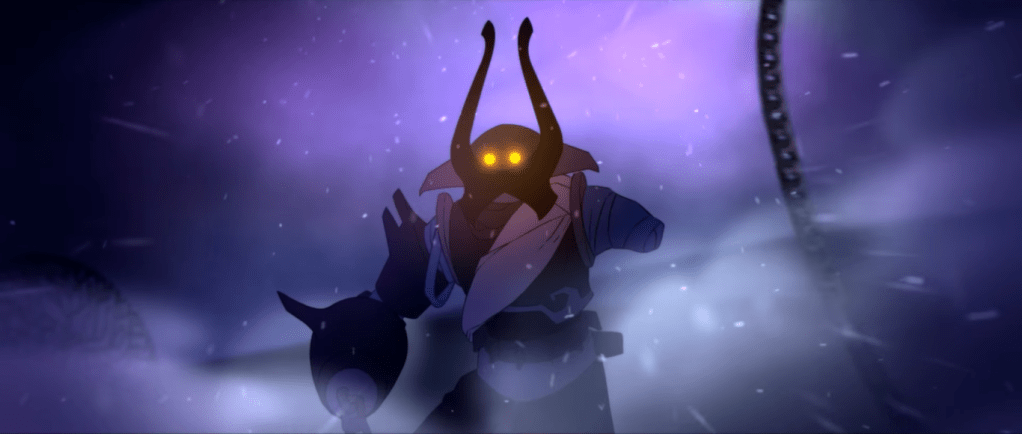
Then, as they enter the tower, Bolverk catches up to them. His first appearance in the game is heralded by the Dredge textures. The party escapes him by jumping into a massive hole inside the tower, which leads them into an inner earth beneath the ground. In that place, they will travel to a white tower, their final destination. Exhausted by the journey, furious at Juno and Eyvind’s evasive behavior and their unwillingness to explain anything to the Ravens or Iver wears down the group. After a particularly dangerous event, they demand answers from the mender, so Juno finally explains everything.
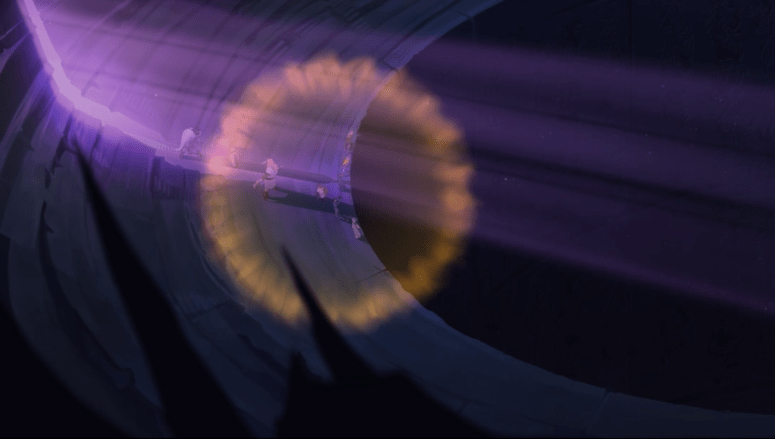
It’s at this point that Wintory peels off the final layer of Juno’s theme, revealing it for what it’s actually been all along– a love theme, one for her and Eyvind. A love story is at the heart of the events of the trilogy. Juno meddled with forbidden magic in order to heal her beloved Eyvind’s illness, and Eyvind broke the world trying to revive his beloved Juno after she was sentenced to death for her meddling.
The middle cue in With a Mighty Grief that was Ours and Theirs scores the revelatory cutscene (from 4:20 to 5:29), while the subsequent cue (from 5:29 to 6:48) scores the conversation that comes afterwards. Juno’s theme swells up in luscious and romantic harmonies, the Naigus Quartet performing the melody with warmth and delicacy. For a moment, we truly understand the love that these characters feel for each other and the inherent tragedy that will always permeate their story. In order for the Darkness and the Serpent to be stopped, Juno must be sacrificed. There is seemingly no other way for the world to be saved.
This brings us to the final stretch of both storylines. After Ruin was repelled, the Dredge retreated, but the Hero is encouraged by allies to open the gates to them, convinced that they aren’t the enemy. The Darkness and the Warped are. The Dredge are just as desperate to survive as the humans and varl are. The Hero has one of two choices, open the doors or not. If they leave the gates closed, nothing happens and the game keeps going.
However, if the Hero chooses to let the Dredge in, they will eventually find themselves on the other side of the walls, outside Arberrang, trying to broker peace with the Dredge.
The track We Live as We Will Live scores this entire, crucial point in the narrative, but the way it works in-game ultimately depends on various factors. The Hero inviting the Dredge inside Arberrang riles up the crowd of people inside the walls and, in the middle of the conversation, a spear flies towards the Hero. At this point, one of two things will happen. A choice made as early as the first game will determine whether the spear hits. If the right choice was made, a Dredge warrior protects the Hero. If a different choice was made… the Hero is impaled.
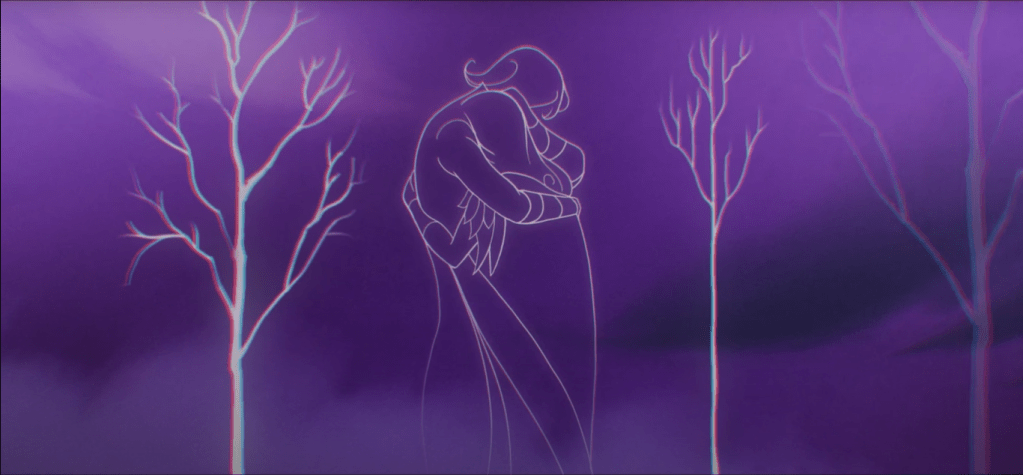
Because Austin Wintory is so good at his job, his score accounts for these ramifications. The first 26 seconds of We Live as We Will Live score the nerve-wracking walk of the Hero towards the Dredge. Should the Hero die, a cutscene plays out. A small burst of the war-torn variation accompanies the Hero as they fall to the ground (0:27 into the same track) and life leaves their body. From the afterlife, Alette calls to Rook, Rook calls to Alette. Then the Hero dies.
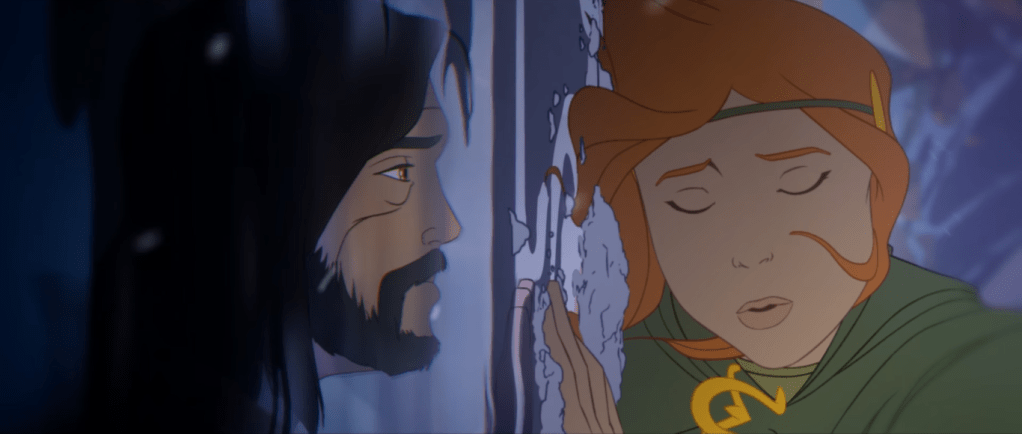
The final days are upon the people at Arberrang. Their only hope is holding out long enough for Juno and Eyvind to reach the white tower and stop the ending of the world. The game jumps back to the trio and the Ravens at this point, from here on out it’s all about the journey towards the tower. The concept of how many days Arberrang has left is calculated on various choices; the trio has to make it to the tower before this point. If they don’t, the game jumps back to Arberrang, with the Hero (or their survivors if they’re dead) fending off waves of Warped. The success of these fights is crucial for how many extra days it adds for the others to make it. In total, the game will jump back to Arberrang up to five times– after that, the world ends no matter what.
This is important for two reasons. The first is that a player might do well enough in their choice-making to make it to the tower before the day counter runs out, and thus never get to experience Arberrang after the events at the gate (and before the epilogue). Or they may do just okay, needing to come back one time, or a couple of times to Arberrang.
The second is that each of those five jumps is scored with their own pieces of music. Every single one. Even if a player would have to make ridiculously terrible choices to need to jump back to Arberrang five times (not even I’m that bad)
The fights for the first time back are scored by Feet and Shields Planted. Wintory introduces here a minor idea in the score, his final one before the end. Listen to the 1:45 mark for the flamboyant motif debuting on French horns and flutes. It doesn’t really represent anything. It just accompanies the final stand of the Arberrang survivors against the onslaught of Warped.
Listen to 2:56 on the same track for a statement of the war-torn variation on screaming trumpets. It’s interesting how easily the motif fits as a standard character motif if the Hero is still alive, but also as a war-cry of sorts for the survivors carrying on the fight if the Hero dies.
The motif from Feet and Shields Planted is reprised during the first action portion of With a Mighty Grief that was Ours and Theirs, which plays during the third time back as the situation gets more critical and the Warped crawl their way into the Great Hall of the city. The music is as desperate as the characters fending off a threat that they know they can’t defeat. The thematic interplay here is astonishing. Listen to 2:07 as Wintory treats us to a dazzling statement of the main theme blending with the action motif playing contrapuntally with the war-torn variation. It happens so quickly amidst the complicated writing that it can be easy to miss.
The music for the final two jumps, by comparison, is subdued and muted. The survivors are overrun. Barely anyone is left. Everyone still fighting might as well be doing it out of foolishness than out of actual belief that things can be saved. Listen to On the Promises of Twilight, with the action motif playing almost mournfully at 0:54; the war-torn variation still tumbles about at 1:42, a mere shadow of what it once was. Remember that a player could very likely finish the game before getting to this point. Wintory didn’t need to write this much music, and yet he did, and the game is all the better for it.
Back on the inner earth, the other group finally makes it to the white tower, where Bolverk is expecting them. A final battle ensues, and the Ravens Theme comes into play one final time. The apocalyptic cue of 8:02-11:02 into With a Mighty Grief that was Ours and Theirs scores the final battle.
The brass rips out roaring statements of Juno’s theme (my particular favorite is the one on low brass at 8:30) to meet the Ravens theme on the battlefield. The brass writing is complicated and the performances are thunderous, the musicians giving it their all. It’s all or nothing. If this fails, the world ends.
With Bolverk defeated. It’s time for Eyvind to make a choice. By this point in the game, he’s grown disillusioned with the world and it’s up to Iver to make him hope again and have him make good on his promise to let Juno go to save the world. The trilogy can end in multiple ways, five to be exact. Three of them are some form of saving the world. Two aren’t.
Of course, all five cutscenes portraying the various endings have different cues. Not much is substantive about them, except for the one where Eyvind lets go and sacrifices Juno, saving the world. Juno’s theme explodes as a fanfare before settling into a calmer statement by the Naigus Quartet (listen to the very beginning of Fate, Chosen).
An additional cutscene/conversation will play if the Hero died at the Arberrang walls. They travel to the afterlife and reunite with their family. Rook is with Alette again, Alette is with Rook again. Here, Wintory brings back the original Hero Motif in an emotional setting, performed by Taylor Davis’s violin. If the Hero died, this is our farewell to them.
I wrote above about how the choices made by the player would influence the trajectory of this score’s narrative, and this is the biggest example of it. If the Hero is alive, the war-torn variation remains their motif at the end, the character forever changed by the experiences lived at Arberrang and throughout the journey to get there (and a player’s last time hearing it may be the muted statements during the fourth or fifth jump to Arberrang as opposed to the hopeful and combative statements during the other three). If the Hero is dead, they reunite with their family and the character is allowed a respite among those they love, with the original hero motif coming back as a way to represent them finally finding peace.
If the world was saved, the game ends with a conversation between the survivors at Arberrang, wondering about the future. No music is heard here, Wintory allowing both players and the characters a moment to enjoy the quiet, like a reward for making it through the madness.

And with that, the credits roll. Eivør Pálsdóttir’s vocals ease us into the end credits song, Only We Few Remember It Now. Juno’s theme makes one last appearance as an instrumental bridge. The melody is warm and hopeful, far removed from its usual dour statements during the score proper. The song itself maintains that hopeful, cathartic tone. The trilogy was a rollercoaster, and this emotional send off feels like the right way to end such a difficult journey. Wintory sneaks a final statement of the main theme (as he has for every end credits song in the trilogy), closing off one of the most thematically ambitious game scores these ears have ever heard.
At last, we reach the end of this four-week long coverage on The Banner Saga trilogy. I want to take a small moment to thank everyone who took the time to read these abysmally long rants, whether or not you found them interesting. If anything, I hope this helped you appreciate these scores (and game music as a whole) from a new perspective.
I strove to make this a comprehensive look through the trilogy’s thematic narrative, but even at over 10,000 words, there is some stuff that was left out (most glaringly, I didn’t mention the Árstíðir chants from the second game returning here as an echo of Bolverk’s former self, or even the folk songs written for the caravans’ trips through the Godstones). That is just how insanely detailed Austin Wintory made the music for these games. It truly is a towering achievement in video game scoring. I leave the rest of those nooks and crannies for you, the readers, to pick out when listening to the scores.
For now, my journey through The Banner Saga comes at an end. I can only hope I ever do something on this site that approximates what I’ve done here. Not right now, though. Right now I need a small break. I don’t do things like these every week because they’re massive undertakings and I was already starting to spread a little thin finishing up this one. But I am glad I did this. I believe I’m a much better fan for having done this. I gained a new appreciation for the artform myself after this.
One final thanks to everyone who read. I’ve tried not to insert myself too much into what I write for this site, but this felt like such a milestone that I needed to acknowledge it. I will see you later next month for my final article of the year!
THE BANNER SAGA 3
Music composed, conducted and orchestrated by Austin Wintory
Co-orchestrated by Susie Seiter
Performed by The London Studio Orchestra, featuring performances by Richard Watkins (French horn), Alistair Mackie (trumpet) and David Bishop (baritone saxophone)
Featured solos by Taylor Davis (violin), Kristin Naigus (solo winds), Malukah (vocals), Peter Hollens (vocals), Johann Sigurdarson (vocals), Anthony Parnther (bass sarrusophone), Noah Gladstone (bukkelhorn), Mike Niemietz (prepared electric guitar), Randin Graves (didgeridoo) and Austin Wintory (accordion)
“Only We Few Remember It Now” featuring vocals by Eivør Pálsdóttir, lyrics by Austin Wintory and Alex Thomas, translations by Stefán Már Magnússon
 Game Music Hub