
For those of us that care about interactivity in game scores, combat music implementation can often be a source of frustration. It can be very repetitive, as action games tend to feature a lot of it. Even more so if it’s done the way most games approach combat music– a simple loop that plays out for as long as the player is fighting, and then it fades to silence when the fight is over; at best, the majority of games nowadays have traded the fade-to-silence for proper outro stingers. But it doesn’t solve the fundamental problem– it’s the exact same piece of music playing over and over again.
This problem is magnified tenfold when dealing with an open-world game that is meant to be played for upwards to fifty hours. And while it’s true that there’s no force on this planet that can make a score not feel repetitive after fifty hours, there’s a world of difference in the player noticing that repetition early in the game, as opposed to much later, maybe even near the end of the experience.
Variation is only one of the issues with non-interactive music, though, as its most important one is exactly that lack of interaction. It often doesn’t feel like the score is really saying anything about what the player is doing, and is relegated to setting the mood in the background. Interactive music can be incredibly empowering when done well, and it’s an absolute treat when it feels like the music is responding to you.
Game music interactivity is one of those terribly under-discussed subjects within the game audio community. Everyone seems to have different opinions on why this is the case. All in all, it’s a complex subject, one that requires an understanding of music in ways that are pretty complicated, even more so when it comes to the creation of the systems that will allow an interactive score to function within a game.
Musically, it means having to think about music as a non-linear entity that can begin and end at any moment, and which can go in any number of directions at any point. Sure, it sounds fine just mentioning it like that, but writing music that can behave in that way is actually pretty tough when, for the past… well, hundreds of years, music has been written with a linear approach– a pre-established beginning, middle and ending. In that regard, interactive music is closer in mindset to improvisation, where a musician has the flexibility to take a piece of music in whatever direction they feel like on the spot.
In the case of music systems, a composer who’s more familiar with the ins and outs of audio engines, such as Wwise and FMOD, will be better able to write music that plays to their strengths.
That’s not to say that a composer who’s not well-versed in interactive music systems will automatically do a bad job, as not every game requires a deeply interactive score, but it’s more often the case that a composer who’s experienced working in games will be better able to take advantage of what the medium can do that no others, like film or TV, can.
But every now and again, and increasingly more so when it comes to AAA studios that can afford having sizeable audio teams, a composer who comes from outside of the bubble can knock it out of the park with a score that feels so attuned to the game that it’s almost inseparable.
That is what Ilan Eshkeri and Shigeru Umebayashi’s music for Ghost of Tsushima feels like. Such an essential and powerful part of the experience, to the point that the game wouldn’t be the same without it. Sucker Punch went to painstaking lengths to ensure a deep level of interactivity within the music, particularly when it comes to combat encounters.
But does the fact that their score is so responsive and interactive mean that they are knowledgeable about interactive music systems? Well, no, and Eshkeri has gone on record to say that he doesn’t know a whole lot about music implementation. But when you’re working on a PlayStation exclusive, you’re almost guaranteed a huge asset at your disposal– the backing of the PlayStation Music team.
And it was this guided collaboration between Eshkeri, Umebayashi and the PS team that resulted in the score as you hear it in-game. Ghost of Tsushima is a powerful marriage of great music and the right level of interactivity to enhance what is already a fantastic game.
The way that the combat music ebbs and flows as you fight enemies is such a satisfying experience, so naturally, I had to figure out how that worked. And once I started getting a fair understanding of it, I knew I wanted to share my insights. So strap in, because this is a lengthy one.
Before we get started, a word of warning– while I strive for my writing to be as approachable as possible, this article will dive pretty deep into some technical terms. I do my best to stay away from complicated concepts, but ultimately, interactive music is inherently complicated.
If you’d like a rundown through the basic concepts of interactive music scoring, check out my very first article, where I used Celeste’s music to illustrate them. Loops, stingers, transitions, stems, musical verticality and horizontality, are all explained there.
Ghost of Tsushima’s music systems make extensive use of both horizontal and vertical techniques to shape the score’s behavior. The level of vertical layering in the music is actually quite deep, to such a degree that the engine is able to add or remove individual instrumental lines from most combat cues to support the progression of a combat encounter in real time. In order for this to happen, cues need to be implemented as individual stems, rather than as a fully mixed track.
From a composer’s perspective, this completely changes how the music needs to be written. For Ilan Eshkeri, this meant that the music he provided needed to be written with three purposes in mind:
- Each individual instrumental line within every cue needed to be reasonably interesting by itself.
- Every horizontal segment within each cue could be rearranged in any number of ways and still feel like a fluid piece of music.
- Every cue could reasonably begin and end at any given point and still feel like a complete piece of music.
That way, under rule one, any combination of stems can yield an interesting piece of music (say, for an encounter a cue will be built from small percussion, strings and woodwinds, while for another, it will be bigger percussion, brass and shamisen, and both will be interesting to listen to), under rule two, a cue can have its horizontal segments shuffled and still feel like it makes musical sense, and under rule three, a cue can be responsive enough to end when the game needs it to while still feeling like a properly-developed piece of music.
What you end up hearing on the album, in tracks such as No Mercy or The Way of the Samurai, are a large combination of stems put together. Although, it is important to mention that, ultimately, these album tracks reflect only a portion of the stems that Eshkeri and Umebayashi wrote for their combat cues. There are many alternate stems for most every cue to provide the engine with options, and to alleviate repetition by creating a sense of variation out of basically the same material.
But the audio engine doesn’t randomly choose what music to play. It needs instructions to know what music to play at what moment, and much more complicated choices that we’ll touch on later.
For the systemic behavior of the score in the open world, the game classifies all the music into game states. For the purposes of this game’s music system, a game state is a set of parameters defined by geography, enemy behavior, and the player character.
Ghost of Tsushima features five of them that directly dictate what kind of music should be playing at any given moment. These are:
- Exploration
- Approach
- Infiltration
- Alarmed
- Combat
The Exploration state is when the player is roaming the open-world without engaging enemies, nor being within proximity of them. The game naturally runs on this state, and it tracks variables like time of day, weather, story progression and geography in order to dictate what type of exploration music should be playing (if it’s a sunny day and you’re in Izuhara, just a handful of hours into the game, you’ll get different music than if you were at night, during a thunderstorm, roaming Kamiagata while being way near the end of the story).
The Approach state is more invisible to the player. It mainly tracks geography so that, when Jin gets within a specific distance of enemy presence, exploration music will be deactivated. This way, if a player approaches an enemy group or an encampment, stealth music will be triggered from silence, rather than awkwardly interrupt a serene exploration cue.
The three remaining states are almost entirely contingent on enemy behavior, and they come into action as a player engages a group of enemies. If a player gets close enough to an enemy group, the Infiltration state will be activated, triggering stealth music; if a player alerts the enemies of their presence, the game will shift into the Alarmed state; finally, if the player gets spotted by an enemy, they’ll trigger the Combat state, and a fight will begin.
The five states are designed in such a way that each lead naturally into the other, following this progression:
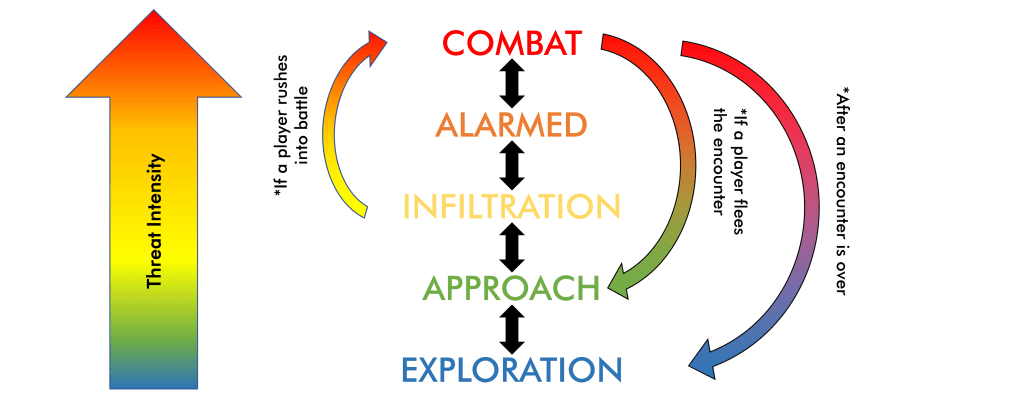
However, there is a lot of nuance in this system, which is lenient enough for the player to circumvent this progression; for example, as it’s shown in the image above, Combat can be triggered directly from Infiltration if a player is quick enough to rush into enemy territory. This also works in the opposite direction, where the player can flee from a fight and the score will transition immediately to silence without the need to revert to stealth music first. Below you can find a reel of examples of Approach and Infiltration in action.
Infiltration and Alarmed
The stealth music is a relatively straightforward affair compared to the more involved nature of the combat music in the game. Its adaptiveness is dictated by the enemies’ level of awareness for the player. In general, there are three such levels, all delineated by the handy awareness meter in the game’s UI.
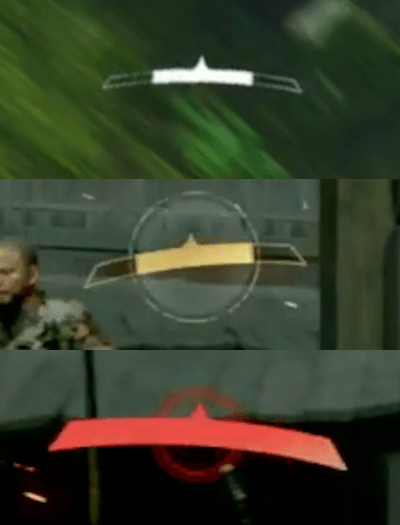
The first level is when an enemy’s awareness meter is empty and is displaying their standard patrol or behavior. This meter can be filled up two times, each for the remaining two awareness levels– the first time makes the meter bar turn golden, and signals the enemy has detected unusual activity and is coming to investigate, while the second time turns the bar red, and signals the enemy has spotted Jin.
These three awareness levels handily correspond with the three game states that I’ll be writing about today, non-awareness being Infiltration, the golden bar being Alarmed and full awareness being Combat.
For the clearest demonstration of the system, we’ll turn towards Mongol forts and other settlements spread out throughout Tsushima. We’ll use the video below for gameplay reference.
Anytime Jin gets near or walks into such enemy territories, the infiltration state will be instantly triggered, with a simple loop of slightly tense stealth music underscoring Jin sneaking their way through the encampment (such as the one playing from 00:06 to 00:56 on that video). With a handful of exceptions, both quest and open-world encounters draw from the same pools of stealth music.
When the alarmed state is triggered, the engine will add a handful of instrumental lines to the cue to create a more ramped up version of it to accompany this rise in tension.
The Alarmed state is unique in that it’s not exclusively dictated by enemy awareness levels like Infiltration and Combat are. In fact, three events may trigger this state, only the first one directly tied to awareness:
- When the player fills up an enemy meter up to gold.
- When an enemy spots a corpse while on patrol.
- When an enemy hears or sees the death of an ally.
The latter two can be triggered without the enemy noticing Jin in any way. But the behavior is the same. Said enemy will call for reinforcements by blowing a horn, alerting every enemy in a wide radius. They will be on high alert for a lengthy period of time as they abandon their patrols and standard behavior, and actively look for the player around the encampment. How long enemies stay alert can be modified by the player equipping certain charms. When the last enemy on alert reverts back to their normal patrol, the game returns to Infiltration, and thus the music transitions back to Infiltration stealth music.
In the video below you can find two examples of the Infiltration and Alarmed states in action. Notice in both of them how it was them hearing or seeing the death of their allies that triggered the change in the music (first at 00:57, and then at 02:32); in neither example did the Mongols actually spot Jin.
While the shift from Infiltration to Alarmed is immediate, the shift to Combat seems to be delayed, even if just by a second from when it’s triggered. Whether it’s intentional or not, it allows for players to take down enemies immediately after getting spotted without triggering combat music. In the video below, at the 00:57 mark, the player manages to kill the Mongol right as they were spotted, and no combat music was triggered. Instead it went to Alarmed because nearby enemies heard the kill regardless.
But even if Combat is actually triggered, rather than immediately jumping into proper combat music, there’s a second buffer in place should the player think of using tools like the smoke bombs to get away at the last second.
Every systemic combat cue is built with a non-looping intro that is usually 5-10 seconds long before it fully transitions into the looping portion. These non-looping intros, aside from allowing the cue to naturally ramp up the energy coming off of stealth music (as opposed to having the action cue burst in), give a handful of extra seconds for the player to get away. Should they quickly want to go back to hiding, those 5-10 seconds will allow the engine to transition the score back into a stealth cue more effortlessly. Two examples of this are illustrated below.
Both buffers built within the action cues are there to help create a much better musical flow, as they prevent the typical situation so many game scores find themselves in, where you get spotted, action music blasts in, and even if you quickly manage to get back to hiding, the music awkwardly keeps playing until it either fades out or transitions back to silence. It’s unnatural, as music doesn’t work like that. So the slight delay and these non-looping intros allow the music to flow in a much more natural way, and they’re an excellent example of a music system accounting for the player’s behavior.
In some settlements, the Infiltration/Alarmed dynamic sounds very different. Occasionally, the player will hear Mongols playing music as part of their idle behavior. When this is the case, this diegetic music will replace the stealth cue that would usually be playing. If Alarmed is triggered, the in-world music will stop and it’s then that stealth music comes in. The Mongols playing the music don’t have to be the ones alerted for the music to stop, as this shift comes from the global state changing, as opposed to the awareness level of those specific NPCs. You can find an example of this in the video below.
Standoff
A combat cue can actually start from three different places– the first is coming off of stealth music as it’s been discussed, the second is from the Ghost Stance unlocked midway through the game, and the third is from the Standoff mechanic. With it, Jin can challenge up to five enemies before the battle begins as an alternate way of triggering combat (though the number of enemies depends on the skills acquired and armor equipped).
There’s a handful of music stingers in place to underscore these standoffs. While different from each other, they’re all generally made out of low string sustains and percussion accents. There’s very little variation in their behavior, and they generally abide by two rules:
- They almost always start from stealth music, as opposed to silence.
- They almost always transition to a combat cue after the Standoff is over.
The first rule is the most consistent one, as a player needs to be very close to an enemy group to challenge them, and just by virtue of proximity, Infiltration music would’ve been triggered by that point. The second rule has three exceptions, but they’re rare enough for a player not to even encounter these in a playthrough:
- Combat music will not be triggered if all enemies present are killed during the Standoff.
- Combat music will not be triggered if a player kills all but one enemy during the Standoff.
- Combat music will not be triggered if a player fails the Standoff, but they’re only engaging a single enemy.
All three examples are presented in the video below. The first exception, illustrated at the 01:26 mark, is self-explanatory, as there’s no need for combat music if there are no enemies to fight; in that case, the ‘Standoff stinger’ simply transitions to silence. The second exception, shown at 01:47, is tied to a system that will be discussed later, but it basically comes down to the engine determining that a single enemy isn’t a high-enough threat to warrant combat music; in that case, the ‘Standoff stinger’ will continue to play until that enemy is dead as well. The third exception, at 02:14, is the rarest, and abides by the same rules as the previous exception.
Combat music will play regardless of the outcome of a Standoff, as there’s still a chance for the player to recover and defeat all enemies if they lose. In the video below, at 00:34, Jin continues to fight the Mongols despite losing the Standoff.
The Threat Music System
A typical Ghost of Tsushima combat cue has a seemingly simple structure. Once triggered, it starts off with a non-looping intro stinger that transitions into the looping section; this plays throughout the entire encounter, and when said encounter it’s over, a non-looping outro stinger helps transition from that to silence. This, in theory, is how the majority of combat music is done across most games.
Where it makes every difference is in the deep verticality I wrote about earlier. This is where it applies to its fullest potential. A combat cue, even while pulling from the same material, can be arranged in any number of ways so that it doesn’t sound exactly the same. These changes are dictated by the game’s audio engine based on a separate set of parameters, which together are called a threat music system.
A threat system, in basic terms, is a system for interactive music created with the purpose of tailoring a musical cue to the specific needs of the encounter that a player is currently engaging with.
These types of systems predate Ghost of Tsushima by a lot, as I’ve heard about them as early as 2009, after the release of the original Dead Space. This game, scored by Jason Graves, used a rudimentary form of a threat system where the music was broken up into four layers (quiet music, normal music, loud music and very loud music), and that game’s audio engine alternated between the four as the situation called for them.
More and more developers have opted for the designing of threat systems for their games, with titles like Assassin’s Creed Valhalla, 2018’s God of War, Returnal and Aliens: Fireteam Elite being some of the most recent examples. No matter the specifics of each of those systems, they are built to address the same issue– the inherent repetition of non-interactive music, and to better adjust the music’s scale to the needs of each specific encounter.
I mean, if you think about it, it’s nonsensical for a huge, climatic action cue to be blasting as a player is fighting chickens, and yet, that’s the way games have worked for decades. Non-interactive music has no regard for what you’re fighting, only that you’re fighting. So the same piece of music that played when you fought those chickens can be the same one playing as you’re fighting a god.
A threat system eliminates such possibilities from ever happening, as the way it works is it calculates the threat level of the enemies the player is fighting, based on stats like number of enemies, health pool, gear, even character level if the game is level-based, and contrasts that against the damage output of the player character, alongside other stats like health, defense or character level. The result is a threat value that, according to whatever thresholds the developers have put in place, determines the level of intensity that the music should have for that encounter. That intensity can go from having no music at all, to having the most bombastic and energetic action music the game has to offer, depending on the kind of fight that the player is facing.
These levels of intensity look different from game to game, and they depend on how granular the interactivity of their score is. In some games, it just means that the devs have a “mild combat cue” and an “intense combat cue” and swap between them as the system deems necessary. For others, it means making additional changes to a cue in real time to adjust the intensity, whether that’s through vertical or horizontal modifiers.
In the case of Ghost of Tsushima, the threat system is meant to control how many instrumental stems are added or removed from a cue playing over an encounter. That way, when the player is fighting tough enemies, the score will be loud and bombastic, full of booming percussion, energetic strings and dramatic brass, but when the player is fighting some random, easily-defeatable group, the music can be more measured.
But what does this threat system look like? Well, at its core, it looks like this:

Heady, right? The earlier drafts of this article actually delved deep into this equation, but it’s not really all that necessary to understand what the game is doing with the music, so let’s just talk about what each of those terms mean for the game.
The Enemy Encounter Value is a numerical value assigned to each individual type of enemy in the game, from animals to humans, and from the different classes of Mongols to bandits or Ronin. As Ghost of Tsushima doesn’t really do character levels, enemy class is a better way of classifying them. The values for each enemy type are these:
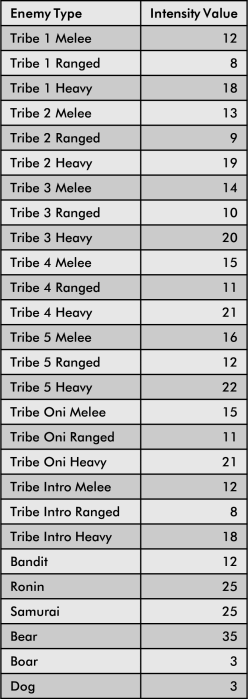
What the game does every time you approach an enemy group is add up the values of all the enemies present and use that as the first number in the equation.
Hero Factor is the value that determines Jin’s strength as the player character. While the game doesn’t do character levels, it does have a progression system for Jin, called Legend of the Ghost. Yes, it’s that handy meter on the far right of the map screen that grants you titles and small rewards every time you fill it up. It can rank up to 10 times, from The Broken Samurai all the way to Ghost of Tsushima. Each of these ranks is tracked by the threat system. But because the math didn’t initially add up with the standard numerical value of the level (from 0 to 10), each level is assigned a different number that can then be used for the equation. The values used for the Hero Factor are as follows:
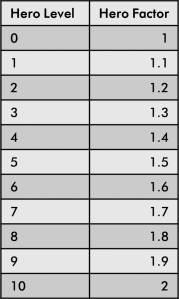
Encounter Difficulty is the result of the equation, dividing the added-up enemy encounter values by the hero factor. Whatever number it throws out is the numerical value of the difficulty of whatever encounter the player is currently facing. This is then compared against a threshold to determine the intensity of the music. In the case of Ghost of Tsushima, there are three thresholds, but only two matter for music:
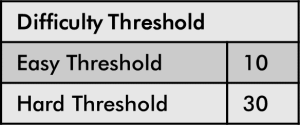
What this means is that, if the encounter difficulty value ends up within the range of 10-29, you’ll get combat music of a smaller scale, and if it’s over that, music will start to ramp up in intensity to account for the higher threat of the encounter. Any number below 10, however, will not trigger music in any way.
Free-roaming animals are a curiosity for the threat system, because they’re technically accounted for by it, with both wild boars and bears having specific encounter values assigned to them. But interestingly, as you can see in the video below, neither of them trigger music in the open world.
With wild boars it can easily be explained away by their encounter values being extremely low, but bears are actually quite high in the ranking, to the point that, even encountering one with a maxed-out Jin gives out a value of 17.5, so firmly within the range of triggering easy combat music. It also doesn’t seem related to their particular behavior (after spotting a player, bears usually observe a player standing on their hind legs before they attack, a behavior triggered based on the player’s proximity), as even fighting it doesn’t trigger music.
This could just be a smart way to avoid playing unnecessary combat music for a situation that doesn’t really call for it (most of my bear kills came from shooting them from afar). After all, it’s not uncommon to be free-roaming an open-world game and triggering combat music every so often because I happened to unknowingly pass by a hostile animal. This helps avoid that altogether.
Where animals do feature into the equation is if humans are already present. One of the more common random events in Tsushima Island is to find either Mongols or bandits fighting a bear; you’ll immediately notice the stealth music triggering as you approach this event. Combat music will trigger here if the player engages.
Bears and boars are sometimes caged within enemy encampments. Should they be freed from their cave during combat, they will also be part of the threat system calculations. A fight with a Mongol group and a bear will inherently be more dangerous than one with just a Mongol group, so the music accounts for that as well.
The game’s threat system works on two levels, one better understood than the other, but both working towards the same goal, which is to tailor the music to the encounter’s intensity.
The first level is what we’ve discussed, which is establishing the rough difficulty of an encounter to determine whether the combat cue that will be triggered needs to be intense or calmer. This calculation is done as soon as Jin approaches an enemy group.
The second level is a real-time calculation of the difficulty values happening as the player kills enemies during the encounter, with the engine being able to modify a combat cue in real time due to the music being implemented in a very granular way. How this happens is that the threat system is constantly keeping track of which enemies are still alive. Each time an enemy dies, their individual encounter value will be subtracted from the global difficulty value, thereby decreasing it. Keep killing enemies, and you’ll start getting a lower and lower difficulty value; as this value drops, the engine starts removing more and more instrumental stems so that, by the time that only one or two enemies remain alive, the music will be at its smallest possible scale.
The first calculation is done to determine, should combat be triggered, the exact number of stems that the engine will require to accompany the fight. The second, continuous calculation is done to actively have the music follow the flow of the fight and better complement the drama of the combat.
The reason why the second calculation is not as well understood is because Sucker Punch hasn’t talked about it in greater detail. I don’t fully understand the threshold values that would dictate these changes, for example. Actually, for all I know, this isn’t even a proper system, and it’s just using the same thresholds as the first calculation, and the engine is just slowly removing layers once the difficulty value has dropped from ‘hard’ to ‘easy,’ but it gives off the appearance of it being more granular than it actually is.
All I’ve written about so far is a combination of what the studio has publicly discussed in conferences and interviews, and my own deductions based on dozens and dozens of hours of playtime and analysis. The only way I could get those details without their help is to crack open the game myself, but my abilities are limited. Until then, what I write about these real-time calculations is based merely on my own observations.
The video below features four examples of open-world combat. In all four, the same rules apply. The first example, at the 00:06 mark, takes place early in the game, and Jin at that point isn’t as high-level as he can get, so the enemies he fights are tough by comparison and the music triggered is intense, full of kakegoe chanting, energetic string ostinatos and booming percussion. As Jin whittles down the Mongol group, the music gets progressively calmer and smaller, to the point of it being just a set of small percussion and subtle shamisen strumming by the end.
The removal of stems doesn’t happen as soon as the number drops low enough. It happens during very specific segments within every cue. There seem to be very specific markers built into every cue where these transitions are allowed to happen. The transition at 01:12 happens seconds after the last Mongol kill rather than immediately after, as the engine waits until a certain point in the cue, and it results in a far more natural transition. After all, a musician wouldn’t suddenly stop playing mid-phrase in any piece of music.
This somewhat extends to the outro stingers that play when an encounter is over; there seem to be custom stingers for different moments within each cue, so that, no matter when a cue ends, it has a way to smoothly transition to silence.
It’s also important to note, before we move on to the next example, that all transitions in this game happen on-beat, meaning that the engine is constantly tracking a cue’s BPM so that, when a new cue or stinger comes in, it triggers, well, on-beat so that it doesn’t sound awkward or mistimed.
The intent with both of these choices is to help preserve the musicality of the score. It’s of utmost importance to have every cue feel like a unified piece of music, not a set of smaller segments that were artificially stitched together.
The third and fourth examples (at 05:21, and then at 06:34) bring up a very interesting topic, which is stem selection. We know that the threat system determines how many stems will be needed for any given cue, but there’s still the matter of knowing how the engine determines which specific combination of stems it triggers.
Both examples use material from the same pool of combat music, which is what’s compiled on the album as the track No Mercy. However, No Mercy only features a fraction of the instrumental stems that Ilan Eshkeri wrote for that. There are alternate lines of strings, percussion, woodwinds and shamisen that vary from encounter to encounter. Among other differences, the third encounter uses a solo cello for the main rhythmic line, while the fourth one is a duet between that and shamisen.
How the engine selects these combinations seems a bit random from my observations. However, it could well be that there’s a separate, more imperceptible algorithm in place that determines these choices.
One thing that could help clarify the situation is that, horizontally, the cues playing over both encounters are different. The cue for the third encounter has a different intro, and it ends up transitioning to a wholly different segment before circling back to the main rhythmic motif. So it may be that it’s not about a handful of huge pools of combat music, but rather a huge number of slightly similar cues, each with a handful of alternate stems to go with.
Whichever way it is, the result of all this real-time tweaking is music that subtly adapts to the player’s own behavior. Music that understands that combat has a dramatic arc just as much as a character does. Music that will co-author an experience with the player, as opposed to passively staying in the background while the player does their thing. Gaming always feels more special when the experience feels tailored to you, and music should always be a part of that.
Interactive music is a complicated subject. I wouldn’t fault more casual readers getting lost amid the talk about equations and stems and threat values and game states. It took me a minute to wrap my head around many of these things. This article, all in all, took me nearly three months to put together. Next time I do something like this, I’ll have a better idea of what I’m getting into.
But it’s so endlessly fascinating, though. It’s music done unlike anywhere else in the world. Video games allow music to exist in such a different form than it has existed in for thousands of years. It’s just mind-boggling that anyone can come up with music that works like that.
And there are plenty of composers advocating for interactivity as a cornerstone of game music, not just as an afterthought. At the front of them is Olivier Deriviere, whose many game scores are always looking to push interactive music forward. I hope to one day have the knowledge to write an article about the interactivity in the music that he writes.
I’m happy to have done this for Ghost of Tsushima, and I should say again that this was only a portion of the systems in place for the music. I didn’t talk about quests, story boss fights, open-world duels, or even smaller mechanics like the Ghost Stance and the poison darts. Music affects all of them, but for now, let’s stop it here. This article was complicated enough as it is.
GHOST OF TSUSHIMA
Music by Ilan Eshkeri & Shigeru Umebayashi
Score produced by Peter Scaturro and Keith Leary
Additional music by Chad Cannon and Bill Hemstapat
Orchestrations by Chad Cannon, Ilan Eshkeri, Jessica Dannheiser and Peter Bateman
Additional arrangements by Marli Wren
Music conducted by Andy Brown and Robert Ziegler
Music performed by London Metropolitan Orchestra
Supplemental material adapted from the originals found here, property of Sucker Punch Productions
Banner features original concept art, property of Sucker Punch Productions
 Game Music Hub